178 Organisations Exposed: The Growing Risk of Software Supply Chain Attacks
In short: On 16 November 2026, an attacker used a flaw at Optimizely to plant malicious JavaScript on the websites of 178 organisations, including banks, media companies and software firms. The victims were not hacked. Their customers were exposed anyway. This is the pattern behind modern software supply chain attacks, and most affected organisations had no browser level defence against it.
The News
Researchers report that malicious JavaScript was written into the Optimizely Web Experimentation projects of 178 organisations. The code was then served to website visitors from Optimizely's own content delivery network (CDN), under a valid certificate, so every visitor to an affected site loaded it.
What the research and the vendor have confirmed so far:
Scale. Scott Helme of Report URI found the code in 188 of the 1,611 Optimizely snippets he checked, belonging to 178 organisations. He says the true number is probably higher.
Timing. The first injection was seen at 04:21 UTC on 16 November. A card skimmer was added at 13:43 UTC. Mass cleanup began around 20:40 UTC and all files were reported clean by 23:11 UTC. For most sites, exposure lasted about 16 to 17 hours.
Who. StepSecurity's sector count shows banking and finance as the largest group (32 organisations), then technology and SaaS (23), retail (20), streaming (12) and news and media (10). Researchers named well known brands among those affected. Not all have confirmed customer impact. Smartsheet, for example, said its application and customer data were not affected.
Optimizely's position. The company says an unauthorised party exploited a flaw in the Web Experimentation account signup flow, impersonated users on targeted customer accounts and inserted the code. It says fewer than 5% of its customers were affected, that the incident was limited to Web Experimentation, and that it is "not a credentials breach". It says it fixed the flaw, removed the injected code, ended sessions, revoked tokens and reset accounts.
The Problem
The problem is not one vendor's bug. It is that a script you do not control, running on pages you do control, can do almost anything a script you wrote could do.
In this incident the script did four things:
Swapped crypto wallet addresses with attacker owned ones, built to pass checksum validation.
Skimmed card numbers typed into first party forms. Payment iframes hosted by another origin were not readable.
Sent cookies and screenshots to attacker servers. Cookies marked HttpOnly were not accessible, but others were.
Tried to attack iPhones and iPads by loading a second stage that researchers link to the Coruna and DarkSword exploit kits. Public scans show exploit pages being delivered. Successful compromise of a device has not been confirmed.
The crypto theft was small. Report URI estimated about $7,040 as of the evening of 16 November, Ostorlab reported $7,150, and Galaxy Digital's Alex Thorn estimated only about $2,300 came from victims, noting much of the Bitcoin looked like the attacker's own funds. Our analysis: that is the least important number. Stolen cards, cookies and device compromises leave no trail on a blockchain, and nobody has published how many were taken.
The business problem is accountability. As George Gerchow of IANS and Bedrock Data told TechTarget, when a script on your page skims your customers' cards, it is your breach. The customer did not deal with Optimizely. They dealt with you.
Why It Happened
Three things came together.
A control plane that publishes code. Optimizely Web Experimentation lets customers write JavaScript in a Project JavaScript field that runs on every page of a project. That is a feature, since experimentation tools are meant to change what a page does. It also means anyone who can write to that field can run code on the customer's site. The attacker, according to Optimizely, got in through an account signup flow flaw and impersonated users on targeted accounts. Researchers note that cross tenant write access is an inference, not a confirmed root cause.
Delivery from a trusted place. The loader sat inside a snippet served from Optimizely's CDN, which most customers had explicitly allowed. This was not CDN cache poisoning, Helme says. The rest of each snippet was left untouched, which made it harder to spot.
Evasion by design. The loader appeared in three forms: a plain script tag, a base64 encoded URL, and an inline copy with an eval fallback. Blocking one domain was not enough.
It also was not the first attack of its kind. In June 2024, Sansec reported that more than 100,000 websites loaded a library from cdn.polyfill.io that was then used to inject malware. Verizon's 2025 Data Breach Investigations Report found third parties involved in 30% of breaches, double the 15% of the year before, across 22,052 incidents of which 12,195 were confirmed breaches. That figure covers third party involvement broadly, not only JavaScript, but it shows the direction of travel.
What Went Wrong
Most of the damage came from gaps on the customer side, and the data shows it.
The Cloud Security Alliance note classified the Content Security Policy (CSP) of 159 affected organisations. A CSP is the browser setting that tells a page which sources it may load from and send data to. The results:
68 (43%) had no CSP at all
50 (31%) had one that still allowed both the payload and the data theft
17 (11%) blocked only the data exfiltration
24 (15%) blocked the payload
Report URI crawled a wider set of 256 hosts and also found 68 with no CSP and 24 that blocked the payload. The denominators differ but the picture is consistent: roughly six in seven classified organisations had no policy that stopped the code from loading.
Specific settings let it through. Allowing cdn.optimizely.com did not help, because the malicious code came from that host. 'strict-dynamic' trusts scripts that a trusted script inserts. 'unsafe-eval', which Report URI says Optimizely's own documentation recommends, allowed the inline variant to run.
TechTarget reports the clearest example: on HSBC's sites, the policy blocked the external payload, but the inline copy still ran because the policy allowed eval. A policy existed and the gap remained. That is a lesson about configuration depth, not a verdict on one bank.
Other failures were operational. Some victims self hosted the snippet but still proxied the live file, so self hosting gave no protection. Experimentation code was loaded on pages where it rarely belongs, such as checkout and login. And the campaign was found by an outside researcher, not by the victims' own monitoring. Helme noted that most affected organisations lacked a CSP or capable monitoring.
What Did the Company Miss?
This section is our analysis, based on the public record. Optimizely has not published a root cause report, so some of this may change.
Access control on a code publishing feature. A signup flow flaw should not allow impersonation of users on other customers' accounts. When the account is a gateway to a field that runs code on a bank's website, identity checks and tenant isolation are not ordinary web app concerns. They are the whole security model.
Detection and disclosure speed. Optimizely says it closed the vulnerability within three hours of detection. But the first injection was at 04:21 UTC, and Optimizely's first status page acknowledgement came at 8:02 pm ET on 16 November, which is 01:02 UTC on 17 November. That is after mass cleanup had started. It has not said when it detected the activity. Report URI also said it had received no response to its earlier outreach at the time of first publication.
Integrity controls that did not fit the risk. The Cloud Security Alliance notes that Optimizely's Cloudflare integrity check hashes only the static core, so it likely would not catch a change to a customer's Project JavaScript.
Guidance that weakens customer defences. If documentation recommends 'unsafe-eval', customers who follow it are opening the same door the attack used.
Transparency. Optimizely told customers the vulnerability was fixed, but researchers say important questions remain: how the impersonation worked, how many accounts the attacker could reach, and which projects were modified.
What the victims missed. No CSP in 43% of the classified cases; permissive CSPs in many more; no inventory or change detection for third party scripts; payment and login pages carrying marketing tags; and no client side telemetry that would have flagged a new script or a new data destination.
Which Products and Services Can Help?
No single product fixes this. Controls fall into layers, and the right mix depends on your estate. These are categories, with examples where our research found vendors publishing relevant guidance. This is not an endorsement or a ranking.
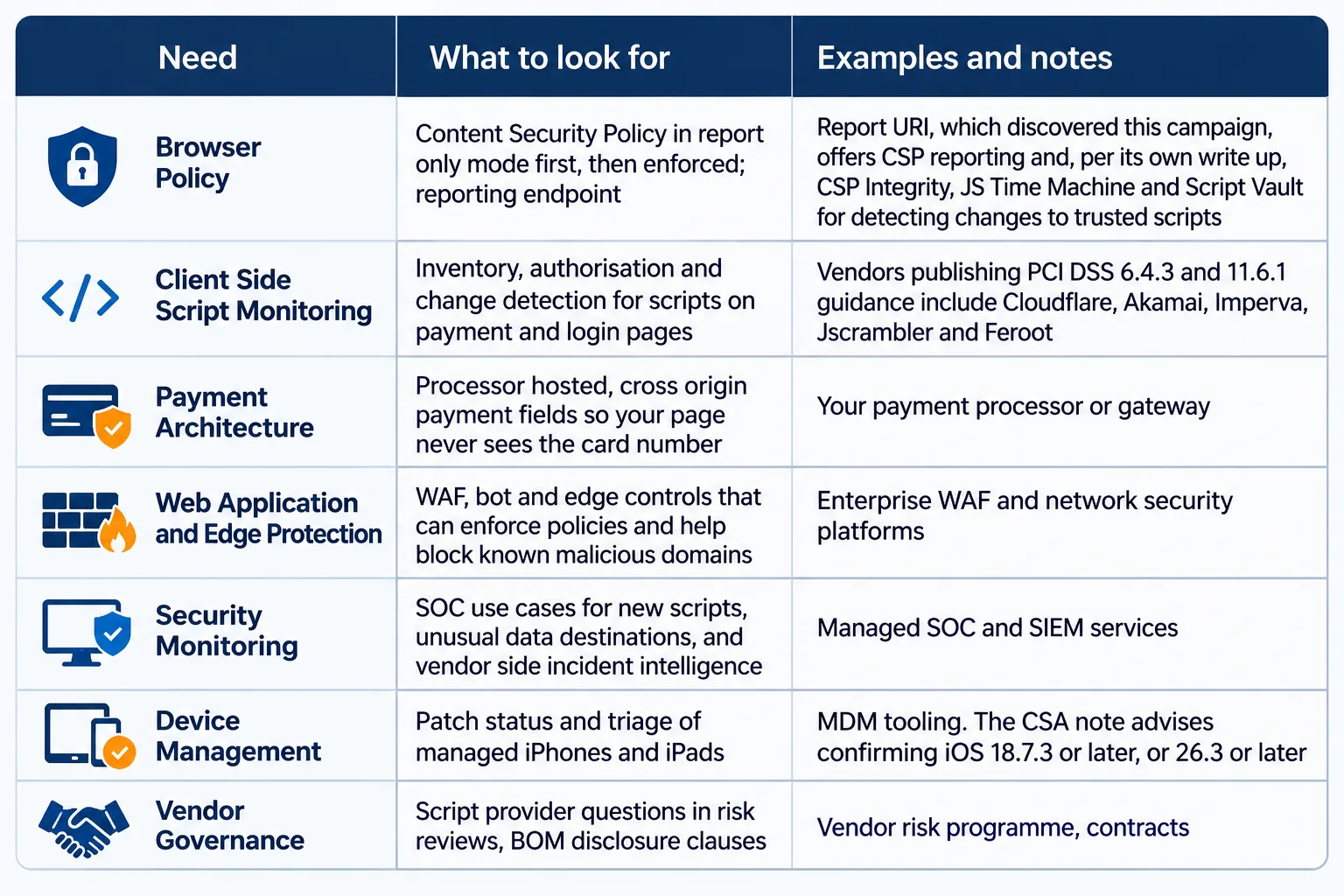
Services matter as much as products. A script inventory, a CSP rollout that does not break marketing tools, a tested kill switch and an incident plan that covers a vendor side compromise are all work, not licences.
How NS3 Can Help
NS3TechSolutions works across cybersecurity, network security, cloud, managed services and IT consulting. For an incident like this, help usually falls into four areas:
Exposure assessment. Map the third party scripts and SaaS integrations on customer facing pages, who owns each, and what data it can reach. Review experimentation, analytics and tag manager projects as well as the code on the page.
Control design. Introduce CSP in report only mode, tighten it in stages, and align payment pages with PCI DSS 6.4.3 and 11.6.1 without stopping marketing from working. Help move card entry to hosted fields where it is not already.
Monitoring and response. Bring client side and web telemetry into SOC workflows so that a new script or a data flow to an unknown destination becomes an alert someone owns. Write playbooks for vendor side incidents, including CERT-In's six hour reporting window and the DPDP breach notice.
Vendor governance. Add technical questions to third party risk reviews, such as who can edit scripts in the vendor's dashboard, whether multi factor authentication and audit logs exist, and how the vendor handles account flow flaws. Align contracts with CERT-In's direction on BOM disclosure.
NS3's technology partners, including Fortinet, Cisco and Palo Alto Networks, offer network and security platforms that can form part of the edge and monitoring layers. Which products fit depends on your environment, and the approach matters more than the badge: start with the inventory, fix the highest risk pages first, and measure whether you can switch a script off within the hour.
Regulatory context that raises the stakes
PCI DSS 4.0.1. Requirement 6.4.3 asks for authorisation, integrity checks and a written inventory of every script on a payment page. Requirement 11.6.1 asks for detection and alerting on unauthorised changes to those scripts and to security relevant HTTP headers. Both became mandatory after 31 March 2025. PCI DSS 4.0.1 softened "necessary" to a business or technical justification.
India's DPDP Rules, 2025. Notified on 13 November 2025, with core obligations for data fiduciaries taking effect on 13 May 2027. They call for reasonable security safeguards such as access controls, monitoring and logging, and retention of logs for breach detection for a year or more. A detailed breach report to the Data Protection Board is due within 72 hours, unless the Board allows longer. The Act's schedule provides for penalties of up to ₹250 crore for failing to take reasonable safeguards.
CERT-In. Cyber incidents must be reported within six hours of noticing them, under the April 2022 directions. CERT-In's Technical Guidelines on Bills of Materials, version 2.0, were released on 9 July 2025. They are not mandatory across the board but are aimed at government, essential services and software exporters, and expectations are likely to cascade to vendors.
Here are a few answers to clarify your questions.
Q- What was the Optimizely supply chain attack?
A- On 16 November 2026, an attacker wrote malicious JavaScript into the Optimizely Web Experimentation projects of 178 organisations, according to researchers. The code was served from Optimizely's CDN and was built to swap crypto wallet addresses, skim card numbers and steal cookies, with an iOS exploit stage as well. Optimizely says it closed the vulnerability within three hours of detection and that fewer than 5% of its customers were affected.
Q- How do I know if my organisation was affected?
A- Review the Project JavaScript field in every Optimizely Web project, including dormant ones. Search logs from 04:00 UTC on 16 November for requests to the indicators published by researchers, including 1688360.cc, and do not rely on one domain, since base64 and inline variants were used. Ask Optimizely in writing which of your projects were modified.
Q- Was this a credentials breach?
A- Optimizely says no. Researchers report that the code could read cookies not marked HttpOnly and capture card numbers typed into first party forms, so session and payment data exposure remains a concern for site owners. HttpOnly cookies and cross origin payment iframes were not readable.
Q- What should we do in the first 72 hours?
Inspect Optimizely Project JavaScript across all projects.
Search logs back to 04:00 UTC on 16 November.
Rotate Optimizely users, API tokens and integrations, and rotate session cookies that are not HttpOnly.
Treat card data entered on affected pages in the window as exposed, and involve your processor, legal team and CERT-In reporting owner.
Confirm managed iOS devices run iOS 18.7.3 or later, or 26.3 or later.
Q- Why did Content Security Policy not stop it everywhere?
Many sites had none, and others allowed settings the attack used. Of 159 classified organisations, 43% had no CSP and 15% blocked the payload. Allowing the Optimizely CDN did not help because the code came from that host, and 'strict-dynamic' and 'unsafe-eval' let loader variants run.
Q- Who is responsible when a third party script steals card data?
A.Contracts may allocate cost between you and the vendor, but customers, card networks and regulators will look first at the site operator. Under PCI DSS 4.0.1 the merchant must authorise, inventory and monitor payment page scripts. Under India's DPDP framework the data fiduciary carries the security safeguards duty. Take advice from legal counsel on your position.
Q- What is the fastest improvement we can make?
A. Remove third party tags from checkout and login pages, and move card entry to processor hosted fields. Both reduce exposure straight away and need no new product. Then deploy CSP in report only mode to see what your pages actually load.
Q. Will SBOMs help with attacks like this?
A. Partly. A bill of materials improves visibility into software components and suppliers, which CERT-In now encourages. It does not detect a vendor account being abused, so pair it with a script inventory, CSP and monitoring.
Q. What happens next?
A. Our analysis, not a forecast from the sources: expect more attacks on the account and publishing layers of SaaS tools that deliver code to customer sites. Expect auditors to ask for script governance beyond payment pages as DPDP obligations arrive in May 2027. Gerchow predicted similar incidents involving enterprise AI agents and plugins. Open questions remain: how the signup flaw reached other tenants, how many accounts were touched, who is behind it, and whether any iOS device was compromised.
The takeaway for IT leaders
The 178 organisations did not fail at patching or perimeter defence. They relied on an assumption that code arriving from a trusted domain stays trustworthy. Treat every third party script as scoped access to your customers: an owner, a reason, a limit on what it can send and a way to switch it off. Teams that can do that in minutes will read the next supply chain headline as news. The rest will read it as a message from a researcher.
Practical checklist: save and share
Do we have a current list of every third party script on login, checkout and account pages?
Does each script have an owner and a written justification?
Can anyone outside our company change code on those pages through a vendor dashboard?
Do vendor dashboard users have multi factor authentication and audit logs?
Does our CSP allow
'unsafe-eval'or'strict-dynamic'?Do we use hosted payment fields?
Would we be alerted if a trusted script changed tomorrow?
Can we disable a third party script across the estate within an hour?
Do contracts require vendors to notify us of incidents and disclose components?
Does our incident plan cover a vendor side compromise, including the six hour CERT-In and 72 hour DPDP clocks?