NBFC Cyberattack: How Hackers Diverted ₹65 Crore in Approved Loans by Exploiting API Security Gaps

A major cybersecurity incident in Delhi-NCR has exposed serious security weaknesses in India's financial services sector.
According to reports, 12 NBFCs (Non-Banking Financial Companies) lost over ₹65 crore in three months after cybercriminals exploited vulnerabilities in their systems to divert approved loan amounts into fraudulent bank accounts.
Key developments:
12 NBFCs reported losses exceeding ₹65 crore.
Delhi Police arrested 20 people in connection with the cases.
Hero FinCorp was among the two named NBFC victims.
Attackers targeted approved loans that were pending disbursement.
Fraudsters reportedly used malware, compromised applications and trusted cloud infrastructure to execute unauthorised transactions.
The issue also triggered cybersecurity concerns at the regulatory level.
On October 9, 2026, CERT-In issued a critical advisory warning NBFCs, fintech companies and payment service providers about attacks exploiting payment and disbursement APIs.
The RBI also issued an advisory on API security and governance on November 16, according to media reports.
The Problem
The biggest problem was not simply that hackers accessed company systems. They exploited weaknesses in the loan disbursement process itself.
The attackers targeted loans that had already been approved but were waiting for payment.
Instead of creating fake loan applications, they manipulated existing disbursement requests and redirected the approved money into accounts controlled by fraudsters.
This created several risks:
Unauthorised access to financial applications.
Manipulation of loan disbursement requests.
Compromised payment gateway and banking API credentials.
Bypassing KYC and transaction verification controls.
Financial losses before organisations detected suspicious activity.
The key lesson: Even an approved financial transaction can become fraudulent if the systems responsible for executing it are not properly secured.
Why It Happened
The attacks reportedly involved multiple security weaknesses.
1. Malware Infection
Attackers compromised the front-end applications of NBFC systems using malware to access sensitive information and identify pending loan disbursements.
2. Vulnerable Applications
Security flaws in public-facing applications provided attackers with an entry point into the financial infrastructure.
3. Exploitation of Trusted IP Addresses
Some NBFC systems trusted specific cloud-hosting IP addresses through firewall whitelisting.
Attackers reportedly exploited this trust by sending fraudulent disbursement commands from infrastructure that the firewall already considered trusted.
4. Stolen API Credentials
CERT-In warned that attackers were stealing payment gateway, payment aggregator and partner-bank API credentials to initiate unauthorised fund transfers.
5. Weak API-Level Validation
Attackers could invoke disbursement APIs directly, bypassing important application-level checks such as KYC, beneficiary verification and transaction limits.
What Went Wrong?
The incident highlights several security gaps that can expose financial organisations to serious cyber risks.
Weak API Security: Sensitive financial APIs were not adequately protected against unauthorised access and manipulation.
Over-trusted IP Addresses: Firewall whitelisting created opportunities for attackers to misuse trusted infrastructure.
Poor Credential Protection: Compromised API credentials could be used to initiate financial transactions.
Application Vulnerabilities: Public-facing applications contained weaknesses that attackers could exploit.
Insufficient Transaction Monitoring: Unusual disbursement activity was not detected quickly enough.
Delayed Reconciliation: In some cases, organisations discovered discrepancies only during later loan reconciliation.
The problem was not just a firewall failure. It was a breakdown across application security, API governance, identity protection and transaction monitoring.
What Did the Companies Miss?
This incident highlights security controls that financial organisations should have prioritised.
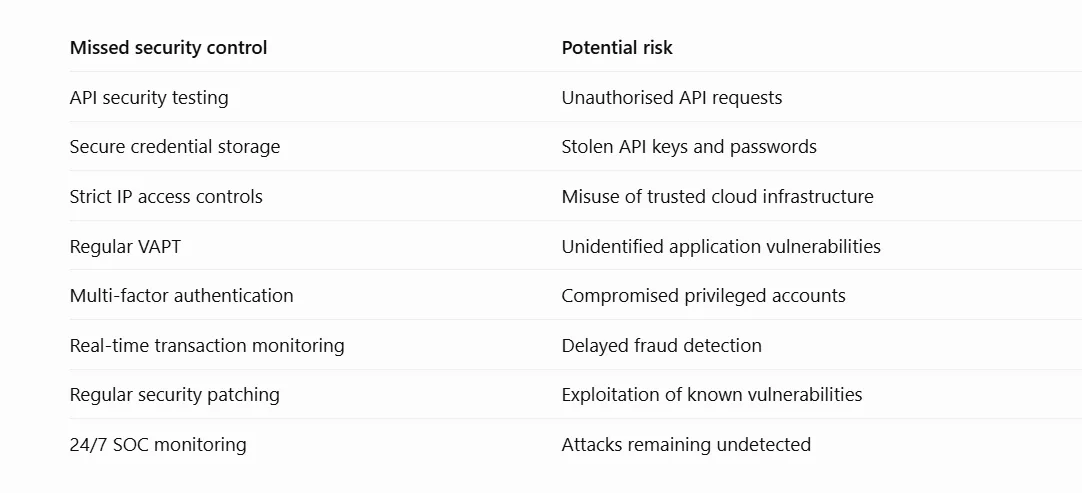
The biggest missed opportunity was the absence of multiple independent security checks before money was transferred.
Financial organisations must verify not only who is accessing their systems but also whether every transaction is legitimate.
Which Products and Services Can Help?
Preventing API-based financial fraud requires a combination of network, application, endpoint, identity and monitoring security.
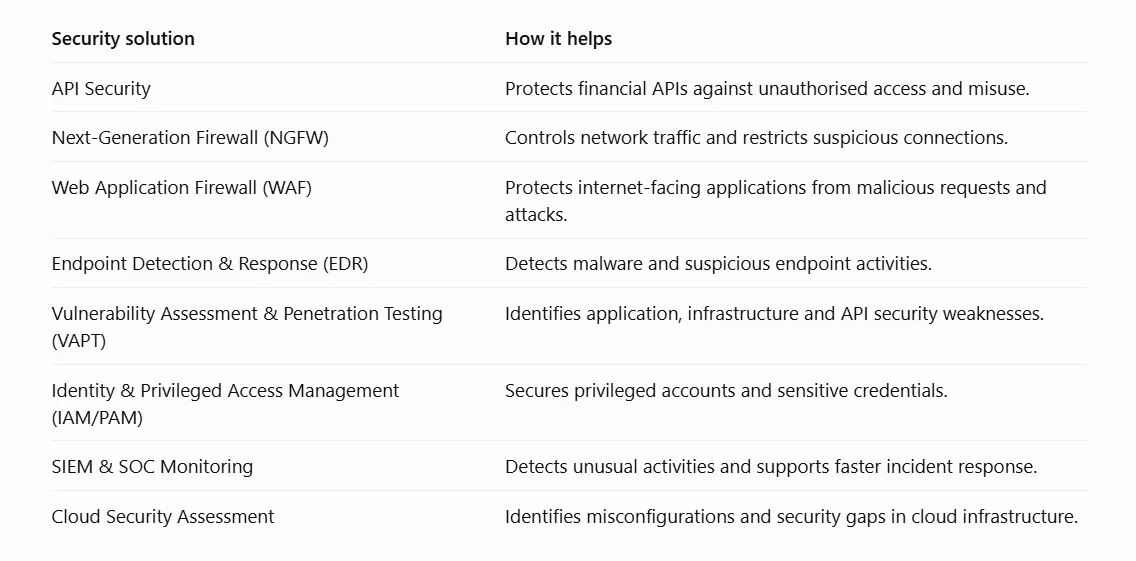
Additional controls should include:
Secure API key storage and regular credential rotation.
Multi-factor authentication for sensitive access.
Maker-checker approval for financial transfers.
Beneficiary validation and transaction limits.
IP restrictions and outbound traffic controls.
Real-time monitoring and automated alerts.
Important: A firewall or WAF alone cannot prevent every form of API abuse. Transaction-level validation and secure API design must also be implemented.
How NS3 Can Help
For NBFCs, fintech companies, banks and payment service providers, cybersecurity should protect the complete financial transaction lifecycle.
NS3 can help organisations strengthen their security infrastructure through the following solutions.
1. API & Application Security
API security assessment and protection.
API VAPT to identify vulnerabilities.
Web Application Firewall (WAF) deployment.
Protection of public-facing applications.
2. Network Security
Next-Generation Firewall deployment.
Network segmentation and access control.
Secure IP whitelisting and traffic filtering.
Network security assessments.
3. Endpoint Security
EDR deployment and endpoint protection.
Malware detection and threat containment.
Endpoint security monitoring.
4. Identity & Access Management
Privileged Access Management (PAM).
Multi-factor authentication.
Secure credential and access management.
5. Managed Security Services
24/7 SOC monitoring.
SIEM-based threat detection.
Security incident investigation and response.
Continuous monitoring of suspicious activities.
6. Security Assessment & Consulting
Vulnerability Assessment and Penetration Testing.
Cloud security assessment.
Infrastructure security audits.
Security configuration reviews and patch management.
The objective is to help financial organisations identify vulnerabilities, secure critical systems and detect suspicious activities before they result in financial losses.
Frequently Asked Questions (FAQs)
Q1. What is API security, and why is it important for NBFCs?
A. API security protects the interfaces that allow financial applications, payment gateways and banking systems to exchange data. It helps prevent unauthorised access, stolen credentials and fraudulent financial transactions.
Q2. How can NBFCs prevent unauthorised loan disbursement?
A. NBFCs can implement API security, multi-factor authentication, beneficiary verification, transaction-level validation, secure credential management and real-time transaction monitoring to prevent unauthorised loan transfers.
Q3. How does Fortinet help protect financial institutions from API-based cyberattacks?
A. Fortinet solutions such as FortiWeb, FortiGate, FortiEDR and FortiSIEM help protect web applications, secure network traffic, detect endpoint threats and monitor suspicious activities.
Q4. What is API VAPT, and why do financial organisations need it?
A. API Vulnerability Assessment and Penetration Testing (VAPT) identifies security weaknesses in APIs by testing authentication, authorisation, data exposure and other vulnerabilities before attackers can exploit them.
Q5. How can 24/7 SOC monitoring help prevent financial cyber fraud?
A 24/7 Security Operations Centre (SOC) continuously monitors systems, analyses security alerts and investigates suspicious activities. It helps organisations identify potential threats and respond quickly to reduce financial and operational risks.