Cloud Resilience After the November 2026 Outages: What Microsoft, AWS, Workday and Apple Missed, and What Your Enterprise Should Fix Now
Two scale figures are worth knowing, with a caution. Cisco ThousandEyes data cited in the RCR piece recorded 419 global outage events in the week of November 9 to 15, against 128 in the comparable week of 2025, and Downdetector and Ookla recorded nearly 6 million US problem reports in the seven days to November 16, about 3.9 million of them attributed to the Microsoft disruption. The author himself notes he could not confirm that monitoring was consistent enough to read the ThousandEyes jump as a real change in reliability. Treat both as signals, not verdicts.
On the attack question, officials were direct. According to a review of public statements, the Director of National Intelligence called the outages not a coordinated or state-sponsored attack, and the FBI's deputy director saw no indication of malicious cyber activity. The same review adds that most organizations have not published enough detail to rule an attack out completely. That is the honest position: no evidence of an attack, and not much evidence of anything else either.
One note on numbers. Microsoft's outage is reported as both roughly 24 hours and roughly 39 hours. Both can be right. Customer impact ran about 24 hours. Measured from the moment Teams began failing over, the incident window was about 39 hours, according to The Register's reading of Microsoft's preliminary report. Some outlets rounded it differently again. When you brief your board, say which clock you are using.
The Problem
The problem is not that a provider had a bad day. Every provider has bad days. The problem is how many business processes now sit behind a handful of shared services, and how little most enterprises can see or do when one of them goes quiet.
Workday shows it clearly. Payroll, timekeeping and benefits are not glamorous systems, but staff could not log in, clock in, check pay or finish benefits enrollment. Emerson College had to extend its open enrollment window to November 16. A service credit does not fix a missed enrollment deadline.
Microsoft 365 shows the same thing at larger scale. Email, chat and Copilot are the connective tissue of most offices. AWS shows a quieter version: the reported problems centred on IAM Identity Center, the sign in path to the AWS Console, plus Amazon Connect, new account sign ups and connectivity for a subset of Network Load Balancer users in one cell. Even a short authentication failure can stop the people who would normally fix other problems.
The cost of this exposure is well documented. The Uptime Institute's 2026 Annual Outage Analysis found that 57 percent of respondents said their most recent major outage cost more than $100,000, and for the second year running one in five reported costs above $1 million. It also found that third party IT and data center providers, which includes cloud, internet, telecom and colocation companies, account for about two thirds of publicly reported outages over nine years of tracking. Outages per site have fallen for five straight years, which is good news, but the ones that happen are expensive, and more of them sit outside your own walls.
Why It Happened
The four incidents had four different triggers, but a pattern runs through them. Nandlall's analysis, which is an expert view and not a confirmed finding, tests five explanations including a coordinated attack and a single shared supplier, and finds the public evidence supports neither. He argues for three more ordinary causes:
Latent defects that survive normal testing until unusual production conditions expose them.
Changes that are poorly contained, so a local change reaches far beyond its intended scope.
Recovery paths that amplify the fault, such as a failover that overloads whatever capacity is left.
Microsoft's own account fits all three. In its preliminary report, Microsoft said a July change to its network gateway servers carried a bug that caused lock contention. It stayed dormant until Teams traffic shifted onto the gateway serving Exchange Online, at a time when about 14 percent of gateway capacity was already out of service for an unrelated reason. On its own, that capacity loss was within headroom. Combined with the other two factors, it was not.
Here is the arithmetic that makes cascades so fast, and it is simple. If 14 percent of servers drop out, each survivor carries about 16.3 percent more load (1 divided by 0.86). Push servers that are near a defect threshold a little harder and they fail, which pushes their load onto fewer survivors. Microsoft reported that more than 80 percent of gateway servers became unresponsive within two hours.
This is our reading, not a finding: modern cloud platforms are built to survive hardware failure, but they are less well prepared for software that fails the same way on every machine at once. Redundancy protects against independent failures. It does very little against a shared defect.
What Went Wrong
Microsoft 365. Microsoft says the defect was worse on machines with more cores and newer hardware, and its load testing used weaker lab hardware. Traffic management then did what it was designed to do, rerouting users away from failing servers, which spread the same load across fewer servers and made the failure more likely elsewhere. Teams, OneDrive and SharePoint could switch to alternative infrastructure and recovered sooner, but Exchange Online could not, which is why email stayed down longest. A normal rollback was not possible because the defective change was months old. Engineers instead built an update that returned the affected code to a previously known good state and applied it in batches. Per Microsoft's timeline, roughly 15 hours passed between the first support case and the mitigation. Microsoft said it has increased capacity, improved monitoring and added safeguards against traffic redirection triggering a similar cascade, and that a final report was due on November 20. We could not confirm its publication at the time of writing. Microsoft has also said this was not a cyberattack.
Workday. Workday's own status notice said tenanted services in the disaster recovery site 'unexpectedly connected to Production databases,' leaving data inconsistent. The company said two data centers were affected and that it was not a cybersecurity incident. In plain terms, the test meant to prove recovery worked caused an outage. Some customers were still reporting limited recovery on Saturday afternoon GMT after the main restoration window.
AWS. AWS published status entries, not a root cause, as of November 18. What is known is limited to symptoms: authentication failures affecting IAM Identity Center, Kiro and Amazon Connect, failed sign ups, and connectivity problems for some Network Load Balancer users until 6:21 AM PST. AWS advised customers to retry failed requests. Anything beyond that would be guesswork, so we will not offer it.
Apple. Apple said an internal update caused the problems and that it was not a cyberattack. It has not said which system changed or why recovery took most of a day for some services. Downdetector also showed about 2,300 US complaints about Apple Pay, although Apple's status records did not list a separate Apple Pay outage.
What Did the Company Miss?
This section is analysis, not reported fact. It is based on what the providers themselves have said, and we try to keep a firm line between the two.
Test environments that did not look like production. Microsoft acknowledged its lab hardware was weaker than production, and the bug got worse on newer hardware. A test that passes on the wrong machine proves little.
A rollback plan that only works for recent changes. Microsoft could not simply revert a change that was months old. Rollback is often rehearsed for last week's release, not for last quarter's.
Failover treated as a safety feature, not a load event. Teams' failover began about 15 hours before Microsoft's connectivity monitor flagged anything (01:07 UTC against 16:03 UTC on November 12, per the preliminary report). A failover changes traffic patterns on the systems it lands on. It deserves the same scrutiny as any other production change.
Disaster recovery testing that could touch production. Workday's test was reported to have connected DR services to live databases. The control that was missing is isolation: a recovery test should be physically and logically unable to write to production.
Communication that left customers planning blind. As of November 18, AWS had published no root cause, Apple had given a one line explanation and Workday's own X account had not posted about the incident as of Saturday morning, according to UC Today. Customers cannot size a fallback plan without knowing whether they face hours or days.
And the customer side. Many enterprises probably discovered they had no independent monitoring, no manual fallback for payroll and time capture, no break glass administrator path into cloud consoles, and no agreed answer to the first question every executive asks: is it us, the provider or an attacker? That last gap is the one most easily closed.
Which Products and Services Can Help?
No product makes a provider outage go away. What the right tools do is shorten the time to know what is happening, give users somewhere to work in the meantime and make recovery a rehearsed procedure. The examples below are categories to evaluate and not endorsements, and the right choice depends on your environment.
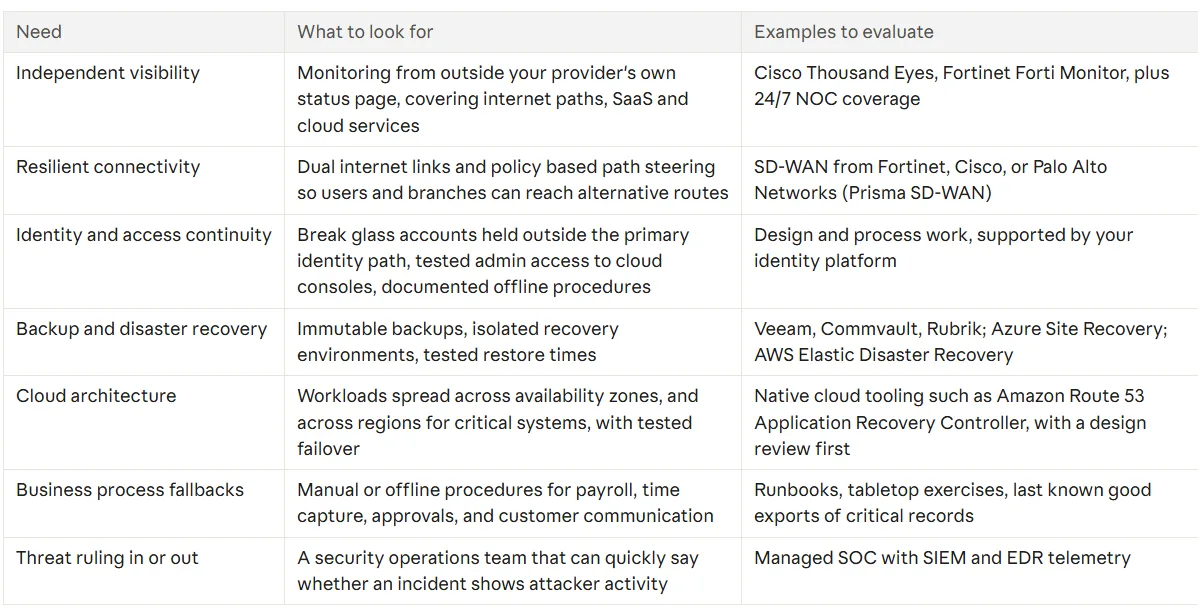
A point worth stressing: backups protect data, not availability. The Microsoft and AWS incidents were availability failures. Having a pristine copy of your mailbox does not help if people cannot send messages for a day. Workday's was a data consistency issue. Recovery planning must cover both questions: can we get the data back, and can the business keep running while we wait?
How NS3 Can Help
Most of the weaknesses above sit in the space between a provider's platform and an enterprise's own network, security and operations. That is where NS3TechSolutions works, across IT infrastructure, enterprise networking, network security, cloud, managed services, SOC and NOC operations and IT consulting. Based on the lessons above, these are the areas where an outside partner adds the most value:
A dependency and recovery assessment. Map which business processes rely on which cloud and SaaS services, set realistic recovery time and recovery point targets for each, and find the shared points of failure: identity, DNS, a single cloud region, a single internet link.
Network redundancy. Design and deploy dual path connectivity and SD-WAN with the OEM platforms an enterprise already runs, so branches and remote users keep working when one path or one provider degrades.
NOC monitoring that does not depend on the provider's status page. External and synthetic monitoring of the services your business depends on, with alerts tied to a runbook and a named owner.
Disaster recovery design and testing. Isolated recovery environments, tested restore times and exercises that rehearse partial failure as well as total loss. The Workday incident is a reminder that the test design is part of the risk.
SOC support during incidents. When something breaks across several systems at once, a SOC can establish quickly whether there is any attacker activity. Ruling an attack in or out early changes how leadership responds.
Cloud architecture review. Honest advice on where multi zone or multi region designs are worth the cost, and where a clear fallback procedure is the better investment.
The starting point is usually modest: an assessment of the five or six business processes that would hurt most if they stopped for a day, and what it would take to keep each one running.
FAQs
Q. Why did Microsoft 365 go down in November 2026?
Microsoft said a July change to its Microsoft 365 network gateway servers contained a defect that caused lock contention. A Teams failover shifted load onto the gateway serving Exchange Online while about 14 percent of gateway capacity was offline, and the defect cascaded across servers. Microsoft said it was not a cyberattack.
Q. How long did the AWS US-EAST-1 outage last?
The main disruption on November 15, 2026 ran from about 3:05 AM to 6:10 AM PST, roughly three hours, with a final network fix confirmed at 6:21 AM PST. It mainly affected authentication through IAM Identity Center, plus Amazon Connect, new sign ups and connectivity for some Network Load Balancer users.
Q. Was the AWS outage a cyberattack?
There is no public evidence it was. AWS has not published a root cause, and reporting describes it as an availability event. Officials said the wider cluster of outages was not a coordinated or state sponsored attack, but that is a statement about the evidence so far, not proof.
Q. Why did Workday go down?
Workday said tenanted services in its disaster recovery site connected to production databases unexpectedly during a DR test, leaving data inconsistent. Payroll, timekeeping and HR services were affected for about 18 hours. Workday said it was not a cybersecurity incident.
Q. What caused the Apple iCloud outage on November 17?
Apple blamed an unspecified internal update and said the problem was not caused by a cyberattack. iCloud sign in, the App Store, iCloud.com and Apple Music were affected. Apple has not published technical detail.
Q. Were these outages connected?
No common cause has been shown. Analysts have found no shared supplier or shared compromise indicator in the public record, though they note that organizations have published little detail. The more useful connection is a pattern: changes, maintenance and recovery actions that spread further than intended.
Q. How should an enterprise prepare for a cloud outage?
Start with a dependency map of critical business processes, then set recovery time and recovery point targets for each. Add independent monitoring, break glass access to cloud consoles, tested backups and a disaster recovery plan, and manual fallbacks for processes like payroll. Run a tabletop exercise at least once a year.
Q. What is the difference between high availability and disaster recovery?
High availability keeps a service running through component failures, usually automatically and within minutes. Disaster recovery restores service after a major failure, usually with defined recovery time and recovery point targets. The November incidents show a third need: planning for a provider that is down while your own systems are fine.
Q. How much does downtime cost an enterprise?
Uptime Institute's 2026 analysis reports that 57 percent of respondents put their latest major outage above $100,000, and one in five above $1 million. Your own figure depends on revenue, payroll exposure, contractual penalties and recovery effort, so calculate it for your critical processes instead of relying on an average.
Q. Should we move to more than one cloud?
Not automatically. A second cloud adds cost, skills and complexity, and a shared defect in your own deployment will follow you. For most enterprises, a better first step is multi zone design, tested backups, a second region for the few systems that justify it, and fallbacks for identity and communication.
What do we do this quarter?
The ten point checklist below is a practical starting point.
List the ten business processes that would hurt most if stopped for 24 hours, and the services each depends on.
Set recovery time and recovery point targets for each, and agree them with business owners.
Put monitoring in place that does not rely on the provider's own status page.
Create and test break glass administrator access to cloud consoles and identity systems.
Confirm dual internet paths, and test failing over between them.
Write manual fallback procedures for payroll, time capture and customer communication.
Test restores from backup and record how long they actually take.
Review DR test design to ensure tests cannot reach production data.
Agree who decides, and within what time, whether an outage is internal, provider or attacker.
Ask key providers when they publish post incident reports and what customers will receive.
The practical lesson of the week is less dramatic than a cyberattack and more useful. The outages that hurt were not caused by an adversary. They came from a build that was tested on the wrong hardware, a recovery drill that touched live data, and a failover nobody treated as a change. Enterprises cannot control any of that at their providers. They can control whether their own business has a second path, a tested fallback and a clear answer when the first question arrives. Build that before the next incident, not during it.