SBI Data Breach Claim: What Enterprise IT Leaders Should Take From It
On 16 October, a cybersecurity account on X flagged a post on BreachForums in which a group calling itself Siriusim claimed to hold 375,000 rows of State Bank of India data and 2,722 PDF files. For five days it stayed a claim. Then, on Wednesday 21 October, SBI told the stock exchanges that the incident was real.
The bank's number was far smaller than the hacker's. Of roughly 3.75 lakh records seen on the dark web, SBI's preliminary review found 3,897 that contained personal information. That gap, between what an attacker advertises and what a victim can verify, is where most enterprises lose control of the story. It is the real subject of this piece, and it reaches well beyond banking.
An earlier version of the social post circulating on LinkedIn still describes this as an unconfirmed claim. As of 22 October 2026, that framing is out of date.
Key Findings and Cybersecurity Implications
It is confirmed, but smaller. SBI acknowledged a cyber incident involving 3,897 records with personal data, against a claim of about 3.75 lakh rows. The bank says core operations were not materially affected.
Row counts are not customers. A dataset of 375,000 CSV rows does not prove 375,000 people, because one person can appear in several loan or lead records.
Small leaks still fuel fraud. Names, mobile numbers, dates of birth and addresses tied to loan leads are exactly what phone scammers need.
Regulators run on your clock, not the attacker's. CERT-In expects reporting within six hours of noticing an incident, so verification has to start the moment a credible claim appears.
What was claimed and what SBI has confirmed
The table below separates the attacker's claim from the bank's own statement. Confirmed facts come from SBI's filing as reported by The Tribune and The Sunday Guardian. Claims come from Cyber Security News.
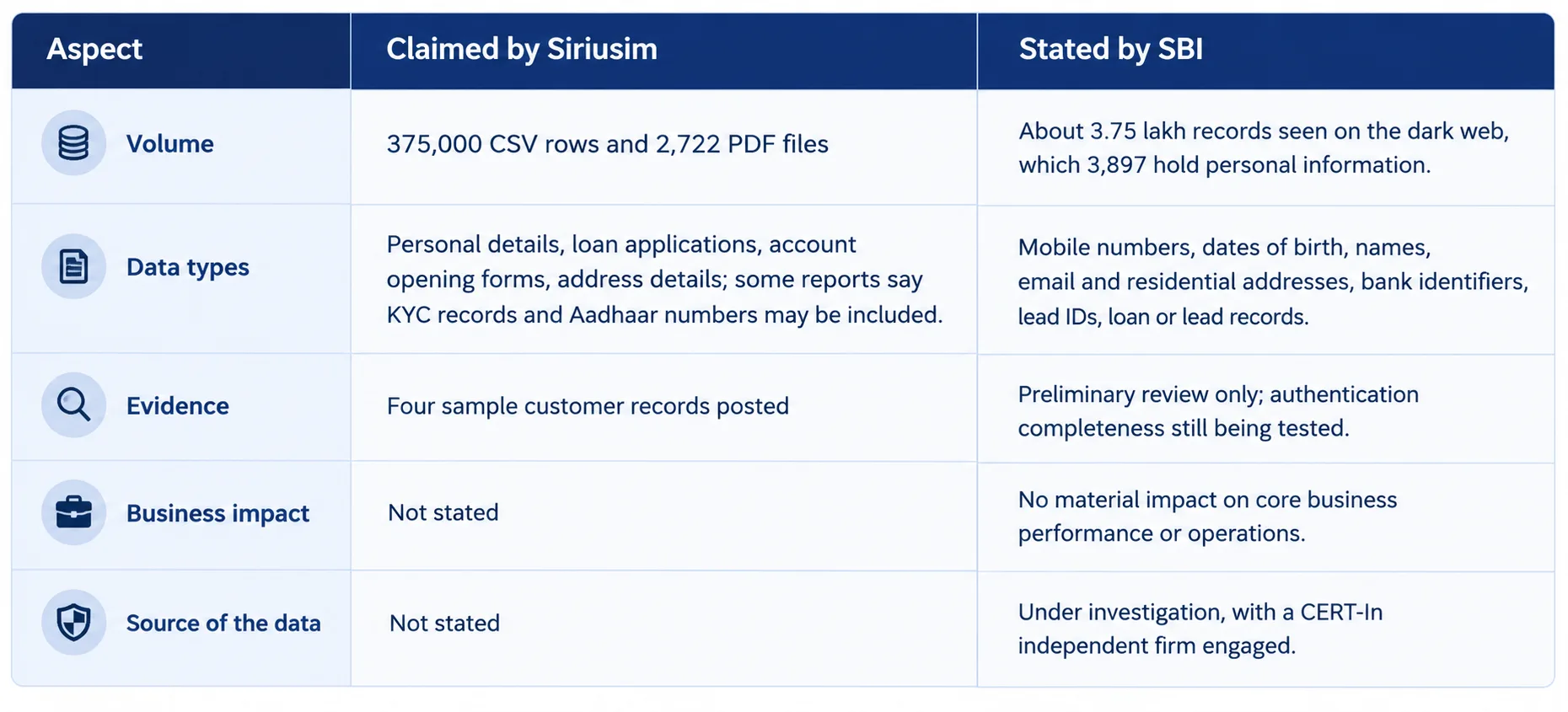
Two things remain open. SBI has not said how the data left its environment, and reports so far do not establish that passwords, NetBanking credentials or UPI PINs were exposed. The bank says it received alerts on 16 October from its threat intelligence provider, the Defence Cyber Agency and CERT-In.
Why this matters to enterprise IT leaders
You do not need to run a bank to face this sequence. A forum post appears, a monitoring account amplifies it, journalists ask your communications team for comment, and your SOC is still trying to work out whether the data is real. By the time you can answer, the public number has already been set by someone else.
The second lesson is about the data. Lead IDs, loan metadata and contact details are not glamorous, yet they are the raw material for convincing calls from a fake relationship manager. A leak of a few thousand such records can power a targeted fraud campaign for months.
The third is about origin. SBI has not said where the data came from. Lead and loan application records often move through origination channels and partner systems, so the pattern is worth watching. That is my inference, not a finding, and the investigation may point elsewhere.
The numbers behind the headline
Incident volumes sound alarming until you separate noise from intrusion. CERT-In figures given to the Rajya Sabha show 5,70,108 banking sector incidents in 2025 and 3,48,607 in the first half of 2026, yet the bulk are scanning and probing. Targeted intrusion campaigns against banks numbered 39 in 2025 and 17 in January to June 2026, according to Outlook Money's report of the reply.
Cost is where the pressure shows. The 2026 IBM study, covered by Deccan Herald, puts the average Indian breach at ₹25.5 crore, a record.
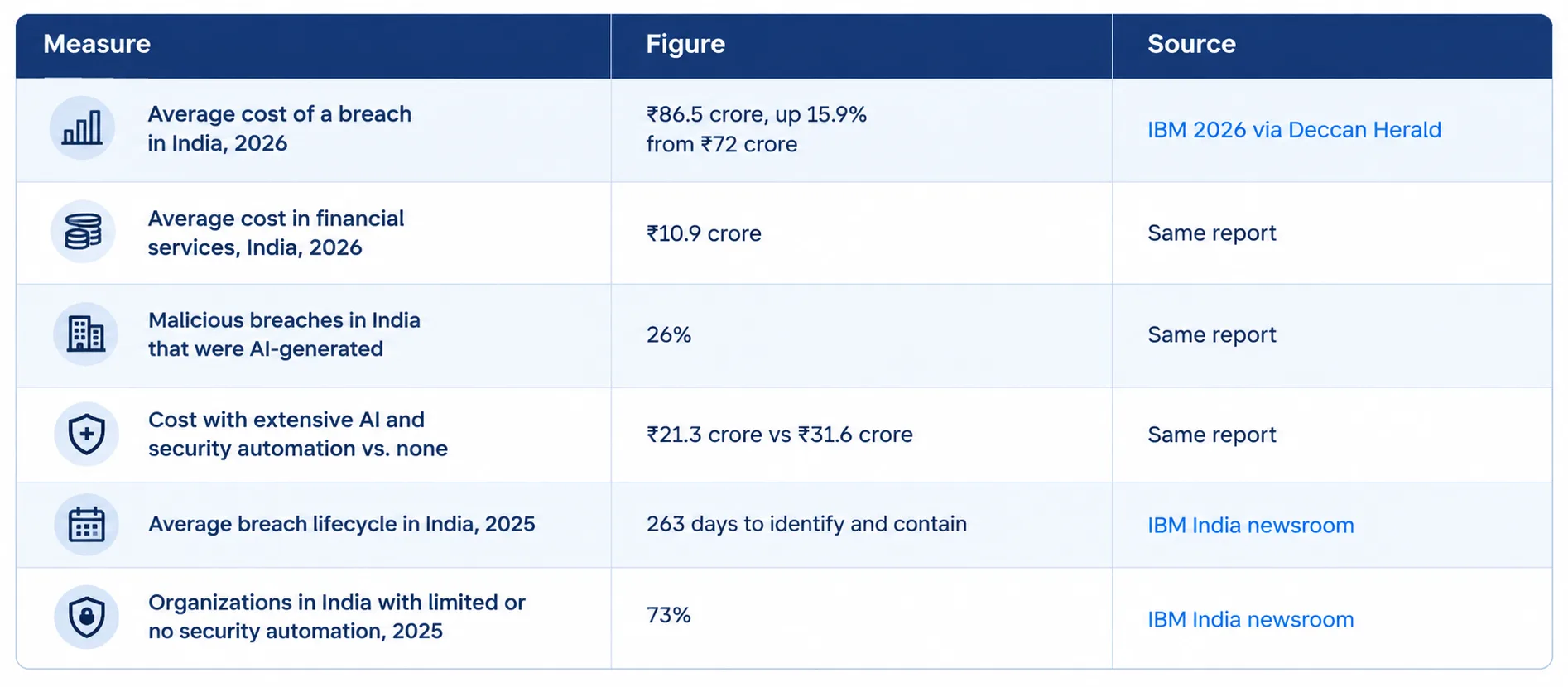
Two readings matter for a CIO. Financial services is the costliest sector in the 2026 study, so a bank is not a quirky example. And the cost gap between heavy and no automation, about ₹10.3 crore per breach, is the nearest thing to a business case for SOC investment that the data offers. That subtraction is mine, from IBM's two figures.
Risks that get less attention
Counting the wrong thing. Of roughly 3.75 lakh records seen on the dark web, SBI's first review found 3,897 with personal data. Duplicate applications and non personal fields can inflate a dataset. Repeating the attacker's number in your own communications is an avoidable error, and so is dismissing the claim because the number looks inflated.
The second wave of fraud. Breach headlines give scammers a script. Messages claiming to be from the bank, offering to help you secure your account, arrive within days. Customers who read about a leak are the easiest to convince. This is analysis, not a reported SBI finding, but it is a pattern most fraud teams will recognise.
Slow provenance. IBM's India data shows an average of 263 days to identify and contain a breach in 2025. If you cannot trace where a dataset came from within days, your public statements will rest on guesses.
Email and partner paths. Bank of Baroda investigated a July 2026 incident that Moneylife reports it attributed to business email compromise, amid claims of 1TB of leaked data. Two public sector banks facing public claims in under three months suggests attackers are testing the whole sector, not one institution.
Silence that reads as denial. Reports as late as 19 October said SBI had not addressed the claims. Whatever the internal reasons, outside observers fill silence with the worst case.
Regulations and guidelines that shape your response
Two rules apply to most Indian enterprises, and banks carry a third.
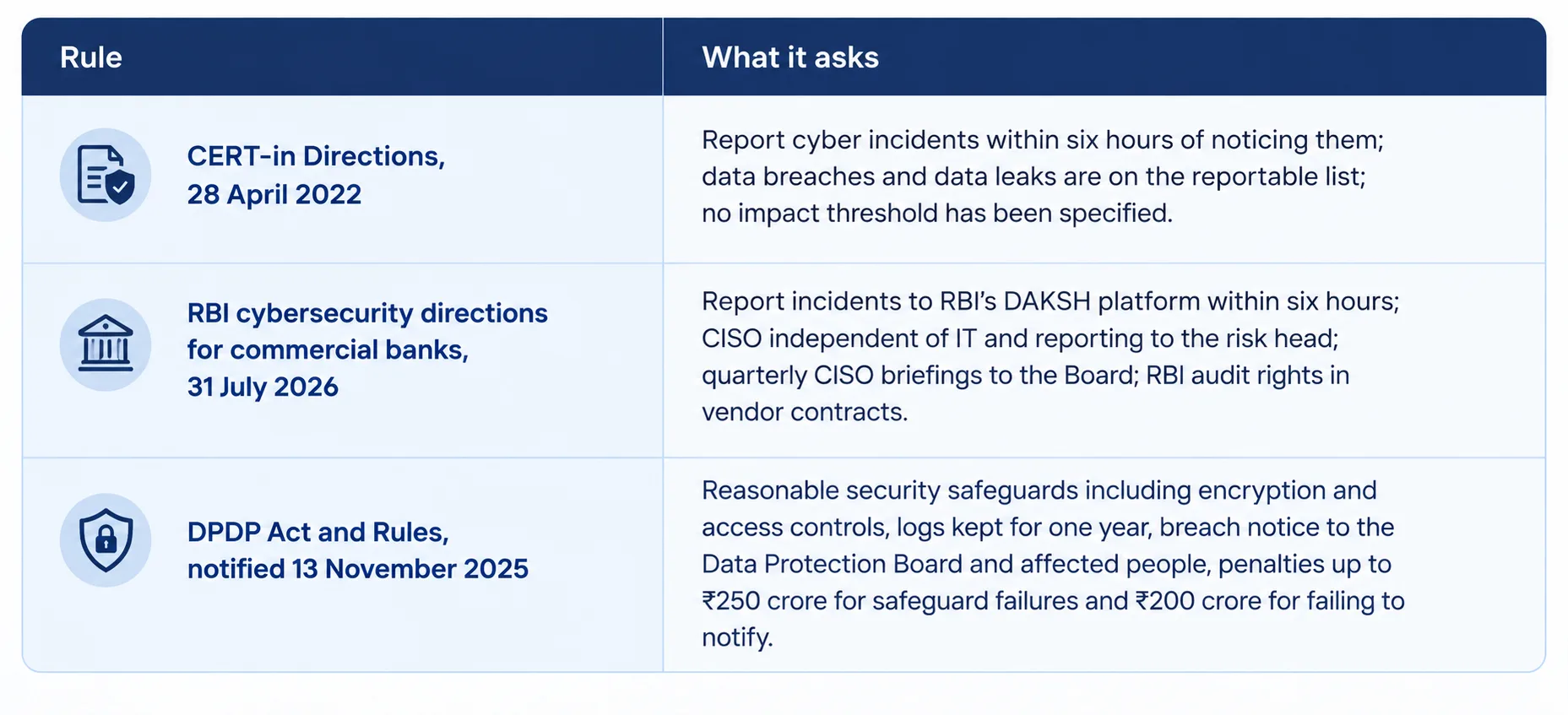
A caution on the DPDP row. Compliance guides summarise the notification mechanics differently: some describe a 72 hour notice to affected individuals, others a prompt notice plus a detailed report to the Board within 72 hours. The DSCI brief and the DPDP summary above are secondary sources, so read the Gazette and RBI texts before you build a playbook around either.
What enterprises should do now
The sequence below is built for the first 72 hours after a claim surfaces, when the facts are thin and the pressure is highest.
Open an incident in the first hour. Treat a credible claim as an incident until proven otherwise. Name an incident commander and start a timestamped log, because regulators will ask when you first knew.
Test the sample data against your own systems. Match posted records to real customers, check which system could have produced those fields, and count unique individuals, not rows.
Decide on regulator notification with legal. Map the claim to CERT-In's six hour window, your sector regulator and, as DPDP duties arrive, the Data Protection Board.
Say only numbers you can defend, then update them. A narrow, accurate statement followed by revisions beats a broad reassurance that later breaks.
Get ahead of secondary fraud. Tell customers the bank will never ask for OTPs, PINs or passwords, point them to official channels, and watch for look alike domains and numbers.
Look at the paths in, not just the data out. Review partner access, shared mailboxes, lead and loan origination systems and privileged accounts around the exposed fields.
Rehearse it. Run a tabletop exercise built on a forum claim rather than a ransomware alert. Most playbooks are written for the second.
Where this is heading
This section is forecast and analysis, not reported fact.
Expect DPDP breach duties to become the main framework for incidents like this. Once they apply in full, a claim of this kind would feed a formal report to the Data Protection Board, and penalties of up to ₹200 crore for failing to notify will change how boards weigh the cost of staying quiet. The exact start date is still unsettled, with an 18 month timeline pointing to around May 2027.
Expect hacker forums to keep acting as the first disclosure channel. The SBI sequence, a post on 16 October and a filing five days later, may become the normal rhythm, with companies measured on how fast they turn a claim into verified numbers.
Expect attackers to use AI more. IBM's 2026 study found 26% of malicious breaches in India were AI generated. Phishing built from leaked loan and contact data is the obvious next use of datasets like this one.
How NS3TechSolutions Supports Enterprise Cybersecurity
NS3TechSolutions works in the areas this scenario touches: network security, cybersecurity, managed SOC and NOC services, cloud and IT consulting. The relevance is practical rather than promotional.
Detection should not depend on a forum post. Round the clock SOC monitoring, with logging that can answer which system produced which fields, shortens the gap between a claim and a verified number. Access paths deserve a review too: privileged accounts, partner connections and shared mailboxes are where many incidents start, and Zero Trust style segmentation limits how far a single compromised path reaches.
Preparation matters as much as tooling. NS3 can help teams build incident playbooks around the CERT-In six hour window and run tabletop exercises that begin with an unverified claim, the scenario most plans skip.
Checklist: when a breach claim lands
Incident commander named and a timestamped log started
Legal and communications looped in within the first hour
Posted sample records matched against internal systems
Unique individuals counted, not rows
CERT-In six hour decision recorded, with the reasoning
Sector regulator reporting duties checked
Partner, vendor and privileged access reviewed for the affected fields
Customer or staff advisory drafted: no OTP, PIN or password requests
Look alike domains and phone numbers monitored
Public statement limited to verified numbers, with an update time promised
Tabletop exercise on an unverified forum claim scheduled this quarter
FAQ
Q. Was SBI actually breached?
A. SBI has acknowledged a cyber incident. On 21 October it said a preliminary review of about 3.75 lakh records on the dark web found 3,897 with personal information. The source and full scope are still under investigation.
Q. How many SBI customers are affected?
A. Not yet known. The confirmed figure is 3,897 records with personal data, but records are not the same as unique people, and the investigation is continuing.
Q. Were passwords or UPI PINs exposed?
A. Reports so far do not establish that. The fields SBI listed are contact and identity details, branch and CIF identifiers, and loan or lead metadata.
Q. Does an unverified hacker claim trigger reporting in India?
A. The CERT-In directions list data breaches and leaks as reportable and set a six hour window from noticing an incident, with no impact threshold specified. Whether an unverified claim counts is a legal judgement, so decide early and record the reasoning.
Q. What should customers do now?
A. Never share OTPs, UPI PINs or passwords, verify calls and messages through official SBI channels, enable transaction alerts, and report fraud on the 1930 cybercrime helpline or the National Cyber Crime Reporting Portal.
Q. How much does a data breach cost an Indian company?
A. IBM's 2026 study puts the average at ₹25.5 crore, up 15.9% from ₹22 crore, with financial services highest at ₹40.9 crore.
Q. When do DPDP breach notification rules apply?
A. The Rules were notified on 13 November 2025 and are phasing in. An 18 month timeline points to around May 2027, and a consultation proposed shortening it, which has not been confirmed.
The takeaway
The SBI episode will be remembered less for its size than for its shape: a claim, a few days of silence, then a filing with a much smaller verified number. The organisations that handle the next one well will not be the ones with the cleverest press line. They will be the ones that can answer three questions within hours. Is the data ours, which individuals are in it, and how did it leave?