What Cybersecurity Controls Should an IT Head Prioritize When Security Budgets Cannot Cover Everything?
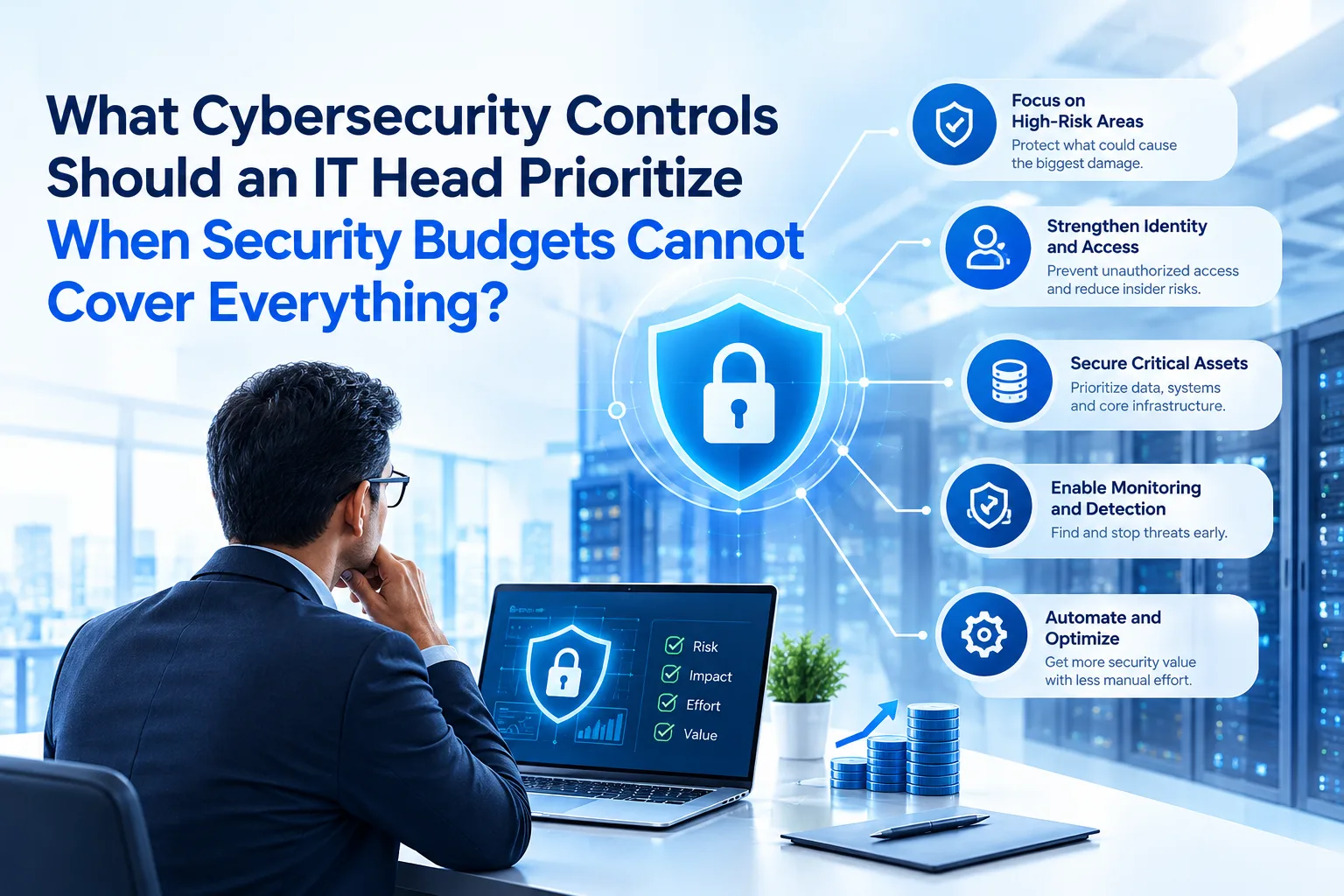
A security team can have the right firewall, endpoint protection, cloud security platform and monitoring tools and still have major gaps.
The reason is simple: security budgets rarely cover everything at once.
An IT Head may need to protect identities, endpoints, applications, cloud infrastructure, networks, data, employees and third-party connections, while also dealing with limited people and limited budgets.
The question therefore is not:
"How do we secure everything?"
It is:
"Which controls reduce the greatest business risk first?"
That distinction matters. When budgets are tight, cybersecurity becomes an exercise in prioritization. The organizations that make those choices well can build meaningful protection without trying to purchase every security product on the market.
The Short Version: Cybersecurity Controls to Prioritize
What is the problem?
Enterprise attack surfaces are expanding while cybersecurity budgets remain limited. More users, cloud services, applications, endpoints and third-party connections mean more areas to protect.
What should come first?
Start with controls that protect identities, reduce common attack paths, limit the spread of a compromise, improve visibility and support recovery.
What does the evidence show?
IBM's 2026 findings highlight the growing financial impact of cyber incidents in India, with phishing emerging as the leading entry point for attackers.
What should be the IT Head’s priority?
MFA and privileged access controls, endpoint and email protection, vulnerability management, segmentation, backups, logging and monitoring, incident response and targeted security testing.
What should not happen?
Buying advanced tools while basic controls remain weak.
The objective is not to create an environment where every possible threat is eliminated.
It is to make the most damaging attack paths harder to exploit, easier to detect and faster to recover from.
What the current evidence says
Cybersecurity spending is often treated as a technology purchasing problem.
It is better understood as a risk allocation problem.
Every organization has more potential security improvements than it can implement immediately. The IT Head therefore needs to decide which investments provide the greatest reduction in business exposure.
IBM’s 2026 findings put the financial risk into perspective, with data breaches in India costing organizations an average of INR 25.5 crore. Phishing was the most common initial attack vector at 19%, followed by drive-by compromise at 16% and supply-chain compromise at 15%.
These numbers do not mean every organization should spend exactly the same way.
They do show that security programmes need to address common entry points as well as more advanced threats.
Identity, endpoints, vulnerabilities, third-party access and recovery therefore deserve attention before an organization starts adding layers simply because they are available.
The principle is straightforward:
Spend first where a control can reduce the greatest realistic business risk.
Why you cannot protect everything equally
A common mistake is treating every asset as though it has the same security importance.
It does not.
An employee laptop, a public web server, a domain administrator account, a production database and a backup server may all be important, but a compromise of each would have very different consequences.
Consider privileged access.
An organization may have approximately thousands of ordinary users but only a small number of accounts capable of changing security policies, creating new administrators or accessing infrastructure.
Those accounts deserve stronger protection.
The same principle applies to systems.
An internet-facing server containing sensitive information deserves more attention than an isolated internal system with limited business impact.
This is why security prioritization should consider:
Business impact + exposure + likelihood + recovery difficulty
rather than simply asking how many vulnerabilities or devices exist.
A useful sequence is:
Protect identity → reduce exposure → limit movement → detect activity → recover quickly.
Which cybersecurity controls should come first?
1. Identity and privileged access
Identity should usually be one of the first areas reviewed.
Attackers do not always need to exploit a sophisticated vulnerability if they can obtain valid credentials.
Start with:
Multi-factor authentication
Privileged access management
Least-privilege access
Separate administrator accounts
Conditional access
Access reviews
Removal of inactive accounts
Strong authentication policies
Privileged accounts deserve particular attention because their compromise can affect the entire environment.
If the budget is limited, strengthening the accounts that can change the environment may provide more value than adding another security dashboard.
2. Endpoint and email protection
Phishing remains a major initial attack route.
That makes email and endpoint security difficult areas to cut.
Organizations should consider:
Endpoint detection and response
Anti-malware
Email filtering
Malicious attachment protection
URL protection
Browser security
Device control
Employee security awareness
The objective is not to assume that employees will never make mistakes.
The objective is to ensure that one mistake does not automatically become a larger incident.
An employee clicking a malicious link should ideally trigger several additional security barriers before an attacker can reach critical systems.
3. Patch and vulnerability management
A sophisticated security architecture cannot compensate forever for known vulnerabilities that remain unpatched.
The first step is visibility.
An IT Head should know:
What assets exist
Which systems are internet-facing
What software versions are running
Which vulnerabilities are critical
Which assets contain sensitive information
Which systems are unsupported
Which vulnerabilities cannot currently be remediated
Prioritization should then consider exposure and business impact.
A critical vulnerability on an isolated internal system may require a different response from a high-risk vulnerability affecting an internet-facing server.
The goal is not simply to achieve a high patch percentage.
It is to reduce the vulnerabilities most likely to become an actual business problem.
4. Network segmentation
Once an attacker enters an environment, the next question is:
How far can they move?
A flat network can make that answer uncomfortable.
Users, servers, administrative systems and critical applications should not necessarily have unrestricted communication with one another.
Segmentation can help limit the blast radius of a compromise.
For example:
User network → Application network → Database network
Administrative access can be separated further, while guest networks can be isolated from corporate resources.
Organizations do not necessarily need a complete network redesign to begin.
A practical starting question is:
Which systems should never be able to communicate directly with each other?
Those boundaries can become the first segmentation priorities.
5. Backup and recovery
Prevention is important, but recovery is equally important.
If ransomware or another destructive attack succeeds, the organization's ability to restore operations can determine the overall impact.
Backups should be:
Regularly created
Protected from unauthorized deletion
Separated from production where appropriate
Monitored
Tested
Documented
The most important question is not:
"Do we have backups?"
It is:
"When did we last successfully restore from them?"
A backup that has never been tested is an assumption.
6. Logging, monitoring and incident response
Security controls are less useful if the organization cannot see what is happening.
Critical systems should generate useful logs, particularly:
Identity systems
Firewalls
VPNs
Critical servers
Cloud platforms
Security tools
Administrative actions
The purpose is to answer basic questions during an incident:
Who accessed the system?
When did it happen?
What changed?
What happened afterwards?
Organizations also need an incident response process.
That process should identify who can isolate systems, who informs management, who handles technical investigation and who manages regulatory or customer communication.
For Indian organizations covered by CERT-In requirements, logging and incident reporting also have regulatory significance.
Which organizations are most exposed?
The priority order will vary depending on the environment.
Cloud-heavy organizations
Identity, configuration and access management become particularly important when applications and infrastructure are distributed across cloud environments.
Multi-site enterprises
More offices, branches and remote users create additional endpoints, network connections and access paths.
Organizations handling sensitive data
Companies handling customer, financial, employee or other sensitive information need to consider the consequences of unauthorized access and data loss.
Organizations with large third-party ecosystems
Vendors and partners can introduce additional access paths. Their permissions should be reviewed just like internal access.
Organizations running legacy infrastructure
Older systems may not support modern security controls. In these cases, segmentation, monitoring and compensating controls can become particularly important.
Where security programmes actually break
A cybersecurity programme can fail even when the organization has purchased good technology.
Too many disconnected tools
An organization may have firewalls, EDR, SIEM, vulnerability scanners and cloud security platforms, but if alerts are not connected and nobody owns the response, the technology can create noise rather than protection.
Basic controls are skipped
Organizations sometimes invest in advanced detection while administrator accounts still lack MFA or critical systems remain unpatched.
Nobody owns the complete outcome
One vendor manages the network, another manages security and another manages cloud.
When something fails between those environments, responsibility becomes unclear.
Day 2 operations are ignored
Security does not end when implementation is complete.
Someone still needs to monitor alerts, tune controls, patch systems, review access and respond to incidents.
This is why cybersecurity should be treated as an operating capability, not simply a technology purchase.
How to prioritize when the budget is fixed
Suppose an organization has ₹50 lakh for cybersecurity.
The wrong question is:
"Which security products can we buy for ₹50 lakh?"
The better question is:
"Which risks can we reduce most with ₹50 lakh?"
Create a simple risk list.
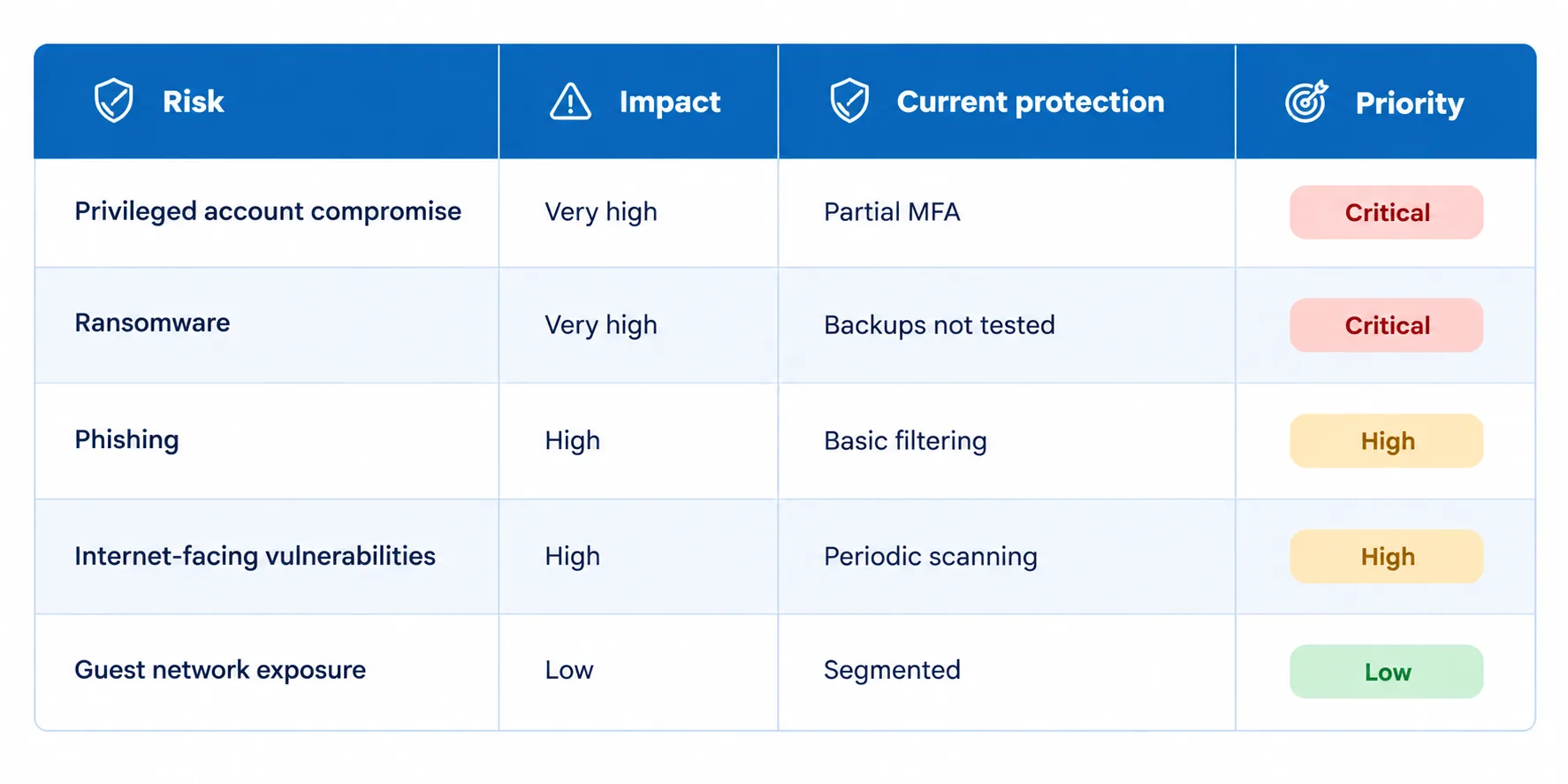
This changes the budget conversation from products to outcomes.
A security investment should be connected to a specific risk.
Ask:
What risk does this control address?
How much could that risk affect the business?
How likely is the risk?
What happens if the control fails?
Can we detect the failure?
Can we recover?
That framework makes limited budgets easier to defend.
What to check before your next security budget cycle
Before requesting additional cybersecurity spending, an IT Head should be able to answer:
Do we know our critical assets?
Do privileged accounts use MFA?
Are inactive accounts removed?
Do we know our internet-facing systems?
Are critical vulnerabilities being addressed?
Are endpoints protected?
Is email adequately protected against phishing?
Are critical systems segmented?
Are backups tested?
Are important logs retained?
Can we investigate an incident?
Do we have an incident response plan?
Has that plan been tested?
Have critical internet-facing systems been security tested?
Do employees know how to report suspicious activity?
Is there one clear owner for security operations?
If several answers are "no", those gaps may deserve attention before purchasing another advanced platform.
The compliance angle for Indian organizations
Security controls also need to support regulatory requirements.
Under the CERT-In Directions issued in April 2022, covered entities are required to maintain ICT logs securely for a rolling period of 180 days, while specified cyber incidents must be reported to CERT-In within the prescribed six-hour window.
The Digital Personal Data Protection Rules, 2025 also introduce additional requirements around personal data protection and breach management, with obligations being phased in.
The practical implication is important.
Infrastructure being designed today should consider logging, access controls, security monitoring and data protection from the beginning.
Adding these controls after an incident or audit can be considerably more difficult.
NS3TechSolutions can support technical readiness, but regulatory interpretation should be confirmed with appropriate legal and compliance professionals.
What happens next
These are forward-looking observations rather than guaranteed outcomes.
Cybersecurity budgets will continue to face competing demands from cloud migration, infrastructure modernization, AI adoption and compliance.
That makes prioritization more important.
Organizations that simply add more tools may create increasingly complicated security environments without necessarily reducing risk.
The stronger approach is to build from the fundamentals:
Identity → Endpoint → Vulnerability → Network → Monitoring → Response → Recovery
Once those foundations are working, organizations can decide where advanced automation, AI security, threat hunting and other capabilities provide additional value.
How NS3TechSolutions Helps Enterprises Prioritize Security
Most organizations do not need another disconnected security product.
They need a clear understanding of where their infrastructure is exposed, which risks matter most and how their security layers work together.
NS3TechSolutions works across enterprise networking, network security, cloud and managed infrastructure services through six phases:
Assess → Architect → Implement → Secure → Operate → Optimize
In practice, organizations can use NS3TechSolutions for:
IT and network assessments
Cybersecurity assessments
Architecture and solution design
Migration and cloud integration planning
Network and security implementation
24x7 SOC and NOC support
L1 to L3 technical support
AMC and monitoring services
Incident management and security tuning
Training and knowledge transfer
The objective is not simply to recommend more technology.
It is to understand the requirement, identify the risk and build the appropriate technology around it.
One important point remains: no technology partner can replace the business owner or executive sponsor. The organization still needs clear ownership of its security decisions.
What a partner can provide is the technical expertise and operational support needed to turn those decisions into a working environment.
Quick checklist
Before approving another cybersecurity investment:
Critical assets identified
MFA enabled for privileged accounts
Privileged access reviewed
Inactive accounts removed
Internet-facing assets identified
Critical vulnerabilities prioritized
Endpoint protection active
Email security reviewed
Critical networks segmented
Backups tested
Security logs retained
Incident response plan documented
Incident response tested
Critical systems security tested
Employee awareness training conducted
Security ownership clearly defined
FAQ
Q. What cybersecurity control should an IT Head prioritize first?
There is no universal answer, but identity and privileged access are strong starting points because compromised credentials can provide attackers with legitimate access to critical systems.
Q. Is MFA enough to protect an organization?
No. MFA is an important layer, but organizations also need endpoint protection, patching, network controls, monitoring, backups and incident response.
Q. Should a company buy a SIEM when the budget is limited?
Not automatically. SIEM can provide valuable visibility, but it depends on good logging, monitoring capability and a process for responding to alerts. Basic controls may deserve priority first.
Q. Should cybersecurity budgets focus on prevention or detection?
Both. Prevention reduces successful attacks, detection limits attacker dwell time and recovery ensures the organization can return to normal when prevention fails.
Q. Do smaller organizations need every security control?
No. Smaller organizations should prioritize controls based on their most important assets and realistic risks. MFA, secure backups, patching, endpoint protection and access management can provide a strong foundation.
Q. How often should cybersecurity controls be reviewed?
Regularly, and whenever there is a significant change to infrastructure, applications, cloud environments, users, vendors or regulatory requirements.
The decision to make now
The hardest cybersecurity budgeting decision is often not deciding what to buy.
It is deciding what can wait.
Every IT Head will have more recommendations than the budget can support.
The answer is not to protect everything equally.
Start with the controls that protect the identities, systems and data that matter most.
Secure the common entry points.
Reduce unnecessary exposure.
Limit lateral movement.
Make important activity visible.
Test recovery.
Make sure someone is responsible for responding when prevention fails.
When the budget cannot cover everything, prioritization itself becomes a cybersecurity control.