CERT-In Cisco Security Alert October 2026: What Enterprise IT Teams Should Check Now

Cisco has told customers that its data centre switches carry a set of critical flaws, and that for most of them the only real fix is a software upgrade and a reload. For Indian enterprises running Nexus switches, UCS Fabric Interconnects or the on premise Cisco licensing server, that turns this month's change window into a security decision.
The advisories went out on 7 October 2026 as part of Cisco's scheduled publication. Cisco says its own security team found the bugs during internal testing, and that it knows of no public disclosure or attacks so far. That status can change quickly once patch details are public, which is why exposure should be checked now rather than at the next quarterly review.
The short version
What happened: On 7 October 2026 Cisco published four NX-OS advisories rated Critical, covering 11 CVEs, plus a separate critical advisory for Cisco License On-Prem (formerly Smart Software Manager On-Prem) covering four more. The top score in the NX-OS set is 9.8 out of 10. The licensing server advisory carries a perfect 10.0.
Is it being exploited? Not as far as Cisco's PSIRT knows. Every advisory states that it is unaware of public announcements or malicious use.
Is there a workaround? Mostly no. Cisco states there are no workarounds for the hardening release flaws or the licensing server flaws. For NX-OS it offers temporary Live Protect shields, and says they do not replace upgrading.
What should you do first? Find out which Nexus, MDS and UCS Fabric Interconnect units you run, which software train they are on, and whether NX-API, NGOAM or MPLS OAM is switched on. Then book the upgrade.
What Cisco published, advisory by advisory
The NX-OS set is the larger story, because Nexus switches sit at the core of many Indian data centres, banks and telecom facilities. The list below uses Cisco's own advisory pages. All were first published on 7 October 2026 at 16:00 GMT.
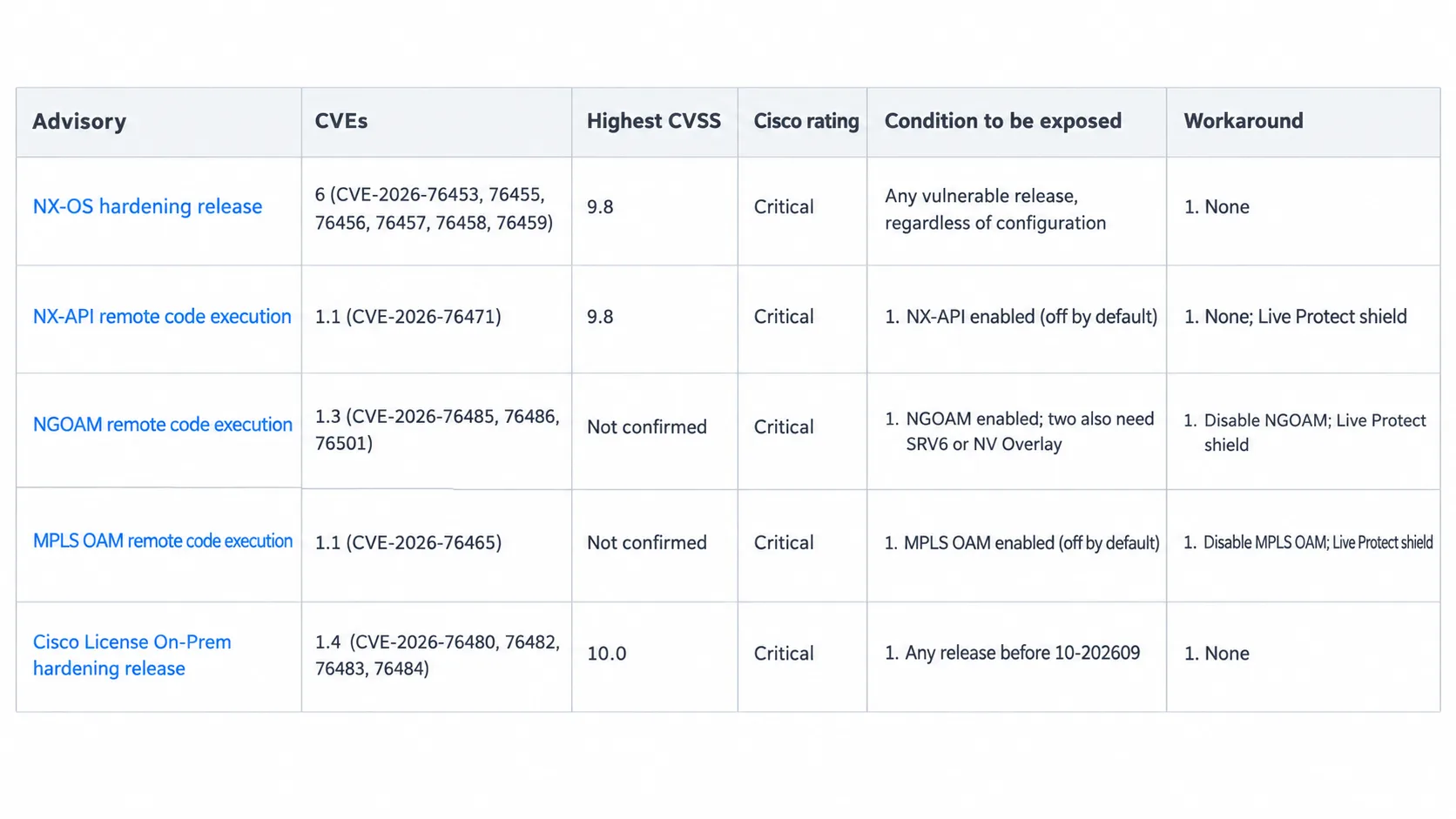
The NGOAM and MPLS OAM rows come from press coverage by BleepingComputer and a developer summary of the advisories. We could not open those two Cisco pages directly, so CVSS scores for them are left out rather than guessed.
A separate pair of NX-OS bulletins is lower risk. CVE-2026-20173 is a control plane denial of service scored 5.8, and CVE-2026-20032 is a Python sandbox escape scored 4.4 that needs a local, low privileged account.
Why the numbers do not match across sources
Readers comparing bulletins will see conflicting counts. Hong Kong's HKCERT listed nine CVEs and called the overall risk Medium, because its bulletin mixed the critical and the minor NX-OS flaws. BleepingComputer counted five critical NX-OS bugs. A developer summary counted 11 across four critical advisories. Cisco's hardening release alone lists six. The sources are counting different slices of the same release. For your own tracking, work from Cisco's advisory IDs, not from a headline count.
Who is actually exposed
Exposure depends heavily on the platform and on what is switched on, and that is where careless reading leads to wasted effort or false comfort.
Nexus 3000 and 9000 in standalone NX-OS mode carry the widest exposure. They are in scope for the hardening release, the NX-API bug and the OAM bugs.
Nexus 7000 and MDS 9000 are in scope for the hardening release. Cisco lists both as not affected by the NX-API flaw.
Nexus 9000 in ACI mode is in scope for the hardening release, but not for the NX-API bug.
UCS Fabric Interconnects (6300, 6400, 6500, 6600 and the X-Series Direct 9108 100G) are in scope for the hardening release. The 6300 series is also reachable through the NX-API bug via UCS Manager, though that path needs valid low privileged credentials, so Cisco lowers it to High.
Cisco License On-Prem is exposed on every release before 10-202609, regardless of configuration. Cisco confirms the Smart Licensing Utility is not affected.
One point deserves emphasis. The hardening release flaws apply on a vulnerable release regardless of configuration. Switching features off will not help there. Only the NX-API, NGOAM and MPLS OAM bugs depend on a feature being enabled.
Why "no known exploitation" is not a reason to wait
Cisco's wording is reassuring on the surface. It deserves a more careful reading.
The flaws were found in internal testing, and Cisco's hardening advisory says the work used existing testing processes and frontier AI models. That detail matters. If AI assisted code review can surface a 9.8 rated bug inside a vendor, the same techniques are available to anyone who studies the patched code. Once fixed releases are public, the gap between a patch and a working exploit tends to shrink. That is our analysis, not a Cisco claim, but it explains why a window of weeks is a risk even when today's exploitation status is clean.
The second reason is where these switches sit. A data centre core switch is rarely patched casually, because a reload can interrupt applications. Teams delay. Attackers know that.
The cost of being wrong is large. IBM's 2026 Cost of a Data Breach study, released for India on 3 August, puts the average breach at INR 25.5 crore, up 15.9% from INR 22 crore a year earlier. Financial services averaged INR 40.9 crore and technology INR 35.7 crore. Globally, IBM found breaches that ran longer than 200 days averaged USD 5.65 million against USD 4.32 million for faster ones. A compromised network core is the kind of foothold that stays quiet for a long time.
What to check this week
Start with inventory, because most delays come from not knowing what is deployed.
List every Nexus, MDS and UCS Fabric Interconnect unit, with model, NX-OS or UCS release, and mode (standalone NX-OS, ACI, UCSM or IMM). Include units at colocation sites and disaster recovery locations.
Run Cisco's Software Checker against each release to find the first fixed version. Cisco's advisories point to it, and the fixed release tables are published in the hardening advisory. For example, Nexus 3000 and 9000 standalone units on the 10.3 train are fixed in 10.3(10), and Nexus 7000 on the 8.4 train in 8.4(14).
Check which risky features are on. Look for NX-API, NGOAM and MPLS OAM in running configurations. NX-API and MPLS OAM are disabled by default, so a unit with them on was configured by someone, often years ago.
Turn off what you do not use. Cisco names disabling NGOAM, NX-API or MPLS OAM as a mitigation where the feature is not needed. This cuts exposure for those three bugs only.
Restrict reachability. Put management, API and OAM traffic behind ACLs and segmentation so that only known management hosts can reach them.
Find your Cisco License On-Prem server. If it runs 10-202608 or earlier, plan the move to 10-202609. If it is still on the old Smart Software Manager On-Prem 9-202601 or earlier, Cisco says to migrate to a supported release, since those versions will not receive the fix.
Plan Live Protect only as a bridge. Cisco offers shields for the NX-OS flaws on units that cannot be rebooted yet. Cisco says they are not a substitute for upgrading. The Python sandbox shield also covers only new CLI sessions, not existing ones.
Watch the logs. Review NX-API access, unexpected process restarts, and unplanned reloads over recent weeks. Cisco has seen no attacks, but your own telemetry is the only check you control.
One practical warning from the advisories themselves: for several product families, the fix requires moving to a newer release train, not applying a point patch. Nexus 7000 units on 8.3 or earlier, and MDS 9000 units on 9.3 or earlier, have to migrate before they can reach a fixed release. Budget extra test time for those.
The compliance angle for Indian organisations
A patch gap is also a regulatory gap, because Indian rules put clocks on what happens after a compromise.
Under the CERT-In Directions of 28 April 2022, covered entities must report specified cyber incidents within six hours of noticing them and keep ICT logs for a rolling 180 days. The DPDP Rules 2025, notified in November 2025, add a detailed breach report within 72 hours and a minimum one year log retention, with obligations phasing in over 18 months. Banks also face RBI's July 2026 cybersecurity directions, and SEBI regulated entities face the CSCRF.
The practical link to this alert is simple. If a core switch is compromised, you will need device logs, with synchronised clocks, going back far enough to show what happened. Many network devices keep little history locally. Confirm that Nexus syslog, AAA and NX-API access logs flow to a central collector, and that retention meets the longest rule that applies to you. Auditors will ask for a record of when you learned of the advisory and what you did. Keep it.
What happens next
These are forecasts and our own reading, not facts.
Expect Cisco's next scheduled publication to carry follow ups, and expect security researchers to analyse the fixed NX-OS builds. If a proof of concept appears for the NX-API bug, which needs only a crafted HTTP request and no login on affected units, the risk for anyone who left NX-API enabled rises sharply. Watch the CISA Known Exploited Vulnerabilities catalogue and Cisco's advisory revision history for any change to the exploitation line.
The larger trend is that vendors are using AI to find their own bugs before attackers do, and the volume of critical advisories may rise as a result. For IT teams, that argues for a standing patch process for network infrastructure, with pre approved windows, tested rollback and a maintained inventory, not a scramble each time an advisory lands.
How NS3TechSolutions Helps Enterprises Respond to the CERT-In Cisco Security Alert of October 2026
Most of the delay in situations like this comes from three questions: what do we have, what is it running, and who can approve a reload. NS3TechSolutions works in enterprise networking, network security and managed infrastructure services, and those are the areas this alert touches. Teams that want help can use NS3 for a configuration and version audit of their Cisco estate, for planning upgrade windows and rollback, and for making sure network logs reach a SOC in the form that CERT-In and DPDP reporting require. The aim is a patched network and a clear paper trail.
Quick checklist
Inventory of Nexus, MDS, UCS and License On-Prem systems with versions and modes
Fixed release identified per platform using Cisco's Software Checker
NX-API, NGOAM and MPLS OAM status recorded, and disabled where unused
Management and OAM access limited by ACL or segmentation
Live Protect shields applied where an upgrade must wait, with a dated plan to upgrade
Change windows booked, with rollback tested
Logs reaching a central collector, with clocks synchronised and retention checked
Incident contacts and the six hour reporting path confirmed
Decision and dates recorded for audit
FAQ
Q. Is Cisco aware of any attacks using these flaws?
A. No. Every advisory states that Cisco PSIRT is not aware of public announcements or malicious use at publication. Recheck the advisory revision history, because that line can change.
Q. Do I need to patch if NX-API is disabled?
A. Yes. NX-API being off removes exposure to CVE-2026-76471 only. The six flaws in the hardening release apply on a vulnerable release regardless of configuration.
Q. Is there a workaround?
A. Cisco lists none for the hardening release flaws or the licensing server. For some NX-OS bugs it offers Live Protect shields and feature disabling as temporary steps. Upgrading is the remedy.
Q. Which Nexus models are not affected by the NX-API bug?
A. Cisco lists Nexus 7000, MDS 9000 and UCS 6400, 6500 and 6600 as not affected by that specific flaw. They remain in scope for the hardening release.
Q. What is the risk to Cisco License On-Prem?
A. Cisco scores it 10.0, the maximum, for the combined advisory. It affects releases before 10-202609 with no workaround.
Q. Does this trigger a CERT-In report?
A. A vulnerability alone does not. A confirmed compromise of an affected device would be a reportable incident under the six hour rule, so prepare the reporting path ahead of time.
The decision to make now
The real question is not whether Cisco's flaws will be used against Indian networks. It is whether your team can move an upgrade through approval, testing and a reload before someone else has worked out how. Companies that can answer that in days will treat this as routine. The rest should treat it as a reason to fix the process.