Cloud Security Vulnerabilities Rise Fourfold: Is Your Enterprise Cloud Infrastructure Protected?

Four in February. Sixteen in November. That is the median number of high or critical vulnerabilities Datadog found in the cloud workloads it analysed, according to its State of Cloud Security 2026 report, released on 10 November. If your team judges cloud risk by the size of the findings backlog, that backlog may be four times heavier than it was at the start of the year, and the cause is not a noisier scanner.
The number is striking, but it is not the most useful thing in the report. The more uncomfortable finding sits beside it: the credentials that open cloud and AI environments are still, in many organizations, permanent. Nearly half of the organizations using Google Gemini rely on long-lived Gemini API keys, and close to a third of AWS IAM users with access keys hold keys more than three years old. Rising cloud security vulnerabilities give attackers more doors. Long-lived keys let them walk through without forcing any of them.
Understanding the Growing Risk of Cloud Security Vulnerabilities
Short answer: cloud security vulnerabilities are rising because enterprises ship more third-party code into more workloads, attackers now exploit new flaws within days, and static credentials remain the cheapest way into a cloud account. Protecting enterprise cloud infrastructure in 2026 therefore depends on three things done together: shortening the time from disclosure to patch for exposed workloads, replacing long-lived keys with short-lived workload identities, and monitoring identity and AI services as closely as servers. Teams that fix only the vulnerability count will still be breached through a key that never expired.
What did the Datadog report actually find about cloud vulnerabilities?
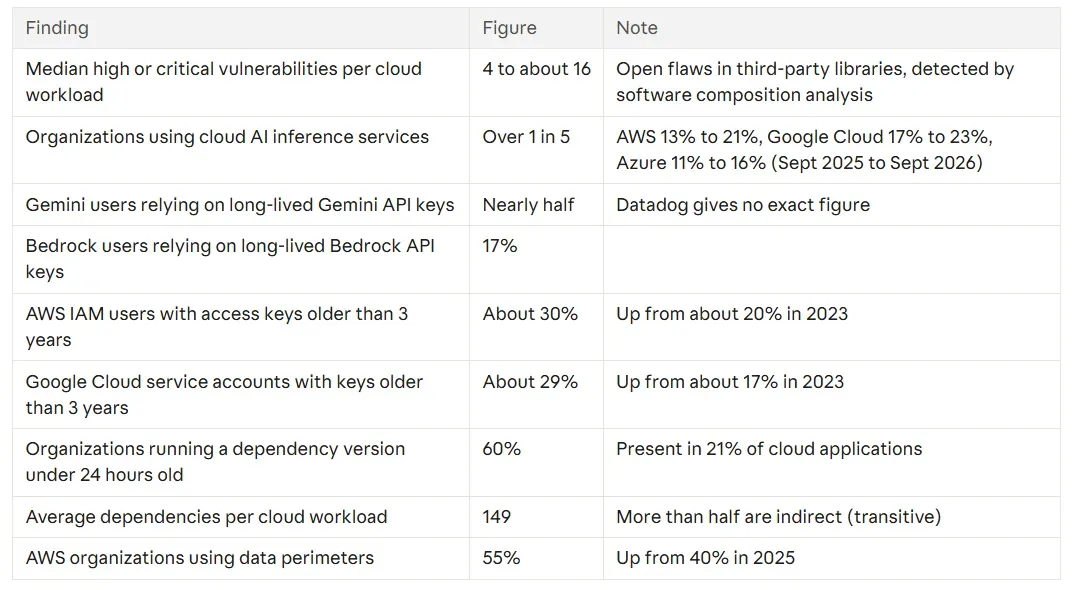
Datadog's State of Cloud Security 2026 draws on telemetry from thousands of organizations using its infrastructure monitoring, logging and cloud security products across AWS, Azure and Google Cloud. The headline is the vulnerability median, but the report covers credentials, AI services, software supply chain and AWS access boundaries as well. The table pulls out the figures that matter most to an enterprise security team.
How should the fourfold number be read?
Carefully, and with its limits in view. The figure is a median across workloads, built from third-party library vulnerabilities that Datadog's Code Security product flagged as open and rated high or critical. It does not count misconfigurations, it does not say how many of those flaws are reachable from the internet, and the report does not define exploitability for this metric. A workload with sixteen buried library flaws behind two layers of network controls is a different risk from one with three flaws on a public endpoint.
It is also a sample of Datadog customers, who tend to be organizations that already instrument their environments. Our inference is that the real distribution outside that group is probably wider, not narrower, because teams with less visibility have fewer ways to know what they are running.
Datadog frames the increase as a consequence of the AI era and calls it a "vulnpocalypse", and it says the growing volume of disclosed vulnerabilities is not a theoretical risk. Trade coverage goes further and names frontier AI as the driver. Treat that as the vendor's interpretation. The measurement is solid; the causal story is still an argument.
Why do some articles say February and others say May?
Because the sources disagree on the starting month. Datadog's own press release says the median rose from 4 in February 2026 to roughly 16 in November, over nine months. Infosecurity Magazine and SC Media report a baseline of 4 in May, with 14 in June and 16 in November. Both versions agree on the starting value, the end value and the fourfold rise. We use Datadog's February framing here because it comes from the publisher, but the shorter May to November window would mean the curve is steeper than the headline suggests. If you quote the figure internally, quote the range and name the source.
Why are long-lived credentials a bigger exposure than the vulnerability count?
A vulnerability has to be reachable, exploitable and matched to a running version before it hurts anyone. A valid access key needs none of that. It works from any network, it carries whatever permissions someone granted years ago, and in the logs it looks like a legitimate API call. That asymmetry is our reading of the evidence, but the numbers behind it are Datadog's.
About 30% of AWS IAM users with access keys hold a key older than three years, up from about 20% in 2023. Google Cloud service accounts moved the same way, from about 17% to 29%. Microsoft Entra application credentials went the other direction: the share of old credentials peaked near 17% in 2024 and sits near 13% in 2026. A key that nobody has rotated in three years is a key that has survived at least one staff exit, one vendor change and probably one migration, with nobody checking who still holds a copy.
Software supply chain incidents show how copies get out. Datadog cites the Shai-Hulud 2.0 malware, which searched infected systems for cloud credentials, and reports that GitGuardian found hundreds of cloud credentials in the data it leaked. A developer laptop or a build runner that installs a poisoned package becomes a credential harvester, and static keys on that machine are the payload.
Is the industry fixing this?
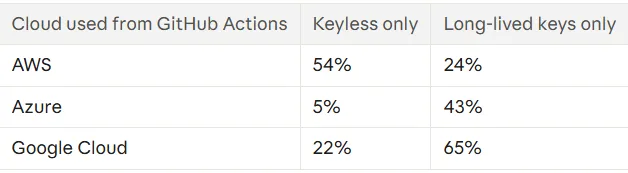
Partly, and unevenly. On AWS, 63% of organizations now authenticate to the console only through single sign-on, up from 55% in 2024, and 54% of those using GitHub Actions with AWS rely only on keyless (OIDC) authentication, up from 37% in 2024. Azure and Google Cloud lag badly on the pipeline side.
How should the fourfold number be read?
Carefully, and with its limits in view. The figure is a median across workloads, built from third-party library vulnerabilities that Datadog's Code Security product flagged as open and rated high or critical. It does not count misconfigurations, it does not say how many of those flaws are reachable from the internet, and the report does not define exploitability for this metric. A workload with sixteen buried library flaws behind two layers of network controls is a different risk from one with three flaws on a public endpoint.
It is also a sample of Datadog customers, who tend to be organizations that already instrument their environments. Our inference is that the real distribution outside that group is probably wider, not narrower, because teams with less visibility have fewer ways to know what they are running.
Datadog frames the increase as a consequence of the AI era and calls it a "vulnpocalypse", and it says the growing volume of disclosed vulnerabilities is not a theoretical risk. Trade coverage goes further and names frontier AI as the driver. Treat that as the vendor's interpretation. The measurement is solid; the causal story is still an argument.
Why do some articles say February and others say May?
Because the sources disagree on the starting month. Datadog's own press release says the median rose from 4 in February 2026 to roughly 16 in November, over nine months. Infosecurity Magazine and SC Media report a baseline of 4 in May, with 14 in June and 16 in November. Both versions agree on the starting value, the end value and the fourfold rise. We use Datadog's February framing here because it comes from the publisher, but the shorter May to November window would mean the curve is steeper than the headline suggests. If you quote the figure internally, quote the range and name the source.
Why are long-lived credentials a bigger exposure than the vulnerability count?
A vulnerability has to be reachable, exploitable and matched to a running version before it hurts anyone. A valid access key needs none of that. It works from any network, it carries whatever permissions someone granted years ago, and in the logs it looks like a legitimate API call. That asymmetry is our reading of the evidence, but the numbers behind it are Datadog's.
About 30% of AWS IAM users with access keys hold a key older than three years, up from about 20% in 2023. Google Cloud service accounts moved the same way, from about 17% to 29%. Microsoft Entra application credentials went the other direction: the share of old credentials peaked near 17% in 2024 and sits near 13% in 2026. A key that nobody has rotated in three years is a key that has survived at least one staff exit, one vendor change and probably one migration, with nobody checking who still holds a copy.
Software supply chain incidents show how copies get out. Datadog cites the Shai-Hulud 2.0 malware, which searched infected systems for cloud credentials, and reports that GitGuardian found hundreds of cloud credentials in the data it leaked. A developer laptop or a build runner that installs a poisoned package becomes a credential harvester, and static keys on that machine are the payload.
Is the industry fixing this?
Partly, and unevenly. On AWS, 63% of organizations now authenticate to the console only through single sign-on, up from 55% in 2024, and 54% of those using GitHub Actions with AWS rely only on keyless (OIDC) authentication, up from 37% in 2024. Azure and Google Cloud lag badly on the pipeline side.
The lesson for a multi-cloud enterprise is that your weakest provider sets your exposure. A mature AWS practice does not protect the Google Cloud service account that a pipeline still authenticates with using a JSON key file. Datadog's recommended pattern is simple to state: let a workload reach cloud services using its own short-lived identity, such as an IAM role, managed identity or service account, instead of a stored secret.
How are attackers going after AI infrastructure and API keys?
Through the same weak points as everything else, only with a faster payoff. Datadog found that more than one in five organizations now use cloud-hosted AI inference services, with adoption in a year rising from 13% to 21% on AWS, 17% to 23% on Google Cloud and 11% to 16% on Azure. Many of those services are reached with a static key pasted into an application.
Datadog Security Labs observed tooling built to test whether stolen AWS credentials can reach Amazon Bedrock, and saw similar probing in 12 organizations' environments over a 30 day period. Andrew Krug, the company's Head of Security Advocacy, put the economics plainly: attackers do not need their own AI model if they can steal the key used to access yours. For a finance team, that sentence translates into a metered bill and, for a security team, into a data access path to whatever the model can see.
IBM's 2026 research adds the governance side. About one in five organizations reported an incident involving an AI system, and 92% of those lacked controls such as role-based access and multi-factor authentication. For breaches that targeted AI systems, IBM names compromised APIs, applications or plug-ins (27%) and cloud misconfigurations affecting AI workloads (27%) as leading causes. In India, IBM puts the extra cost of shadow AI at INR 1.79 crore per breach where it is present.
How fast are attackers exploiting new cloud vulnerabilities?
In days, and sometimes in hours. Google Cloud's Threat Horizons report, published in March 2026 and covering the second half of 2025, found that exploitation of third-party software vulnerabilities accounted for 44.5% of initial access in the incidents it analysed, up from 2.9% in the first half of the year. Weak or absent credentials fell from 47.1% to 27.2% over the same period. The React2Shell flaw (CVE-2025-55182) was exploited for cryptocurrency mining within 48 hours of its December 2025 disclosure, and Google describes the gap between disclosure and mass exploitation as shrinking by an order of magnitude, from weeks to days.
Two cautions. First, Datadog's report quotes the 44.5% figure under a first half of 2026 label, while Google's report places it in the second half of 2025, so check the period before reusing it. Second, a falling share for credentials does not mean credential theft got rarer. Our reading is that exploitation grew so quickly that it pushed every other vector down in relative terms. Credentials still sat behind more than a quarter of the incidents Google analysed.
Google also says its underlying cloud infrastructure remained secure and that attackers were instead hitting unpatched applications and permissive user-defined firewall rules. That is the shared responsibility model in practice: the provider secures the platform, and the exposed workload is yours.
What does this cost when it goes wrong?
IBM's 2026 Cost of a Data Breach research puts the average Indian breach at INR 25.5 crore, up 15.9% from INR 22 crore a year earlier. The global average is $4.99 million, and the mean time to identify and contain a breach rose to 247 days, reversing five years of decline. IBM lists cloud migration among the top three cost increasing factors in India, alongside non-compliance with regulations and shadow AI.
The same data shows what helps. Indian organizations with no AI or security automation averaged INR 31.6 crore per breach, against INR 21.3 crore for those using it extensively. IBM's India figures do not isolate cloud credential or vulnerability exploitation as a cause, so the link to this article's topic is our inference, not an IBM finding: the faster you see an exposed key or a newly exploited flaw in your own estate, the less of that 247 day average you pay for.
Which less obvious risks are enterprises missing?
Speed to adopt new packages. Datadog reports that 60% of organizations run a dependency version released less than 24 hours earlier, in 21% of cloud applications. Fast upgrades feel like hygiene. They are also how a hijacked library lands in production. Datadog's counter is a dependency cooldown, a deliberate delay before new versions are accepted, noting that the community usually contains hijacked libraries within a few hours.
Indirect dependencies. The average cloud workload has 149 dependencies and over half are transitive, which means your team did not choose them and may not know they exist. A median of 16 high or critical flaws per workload is partly a statement about code nobody on your payroll wrote.
Management account sprawl. Datadog found 14% of AWS organizations running EC2 instances in their management account, up from 9% a year earlier. That account sits at the top of the hierarchy, and a compromised workload there is no longer contained to one project.
Triage that stops at the severity score. When the median workload carries sixteen serious findings, patching everything first is not an option. Prioritising by internet exposure, active exploitation and the permissions of the affected workload is the only approach that scales. This is where most enterprise backlogs quietly fail.
Which regulations and standards apply to cloud security in India in 2026?
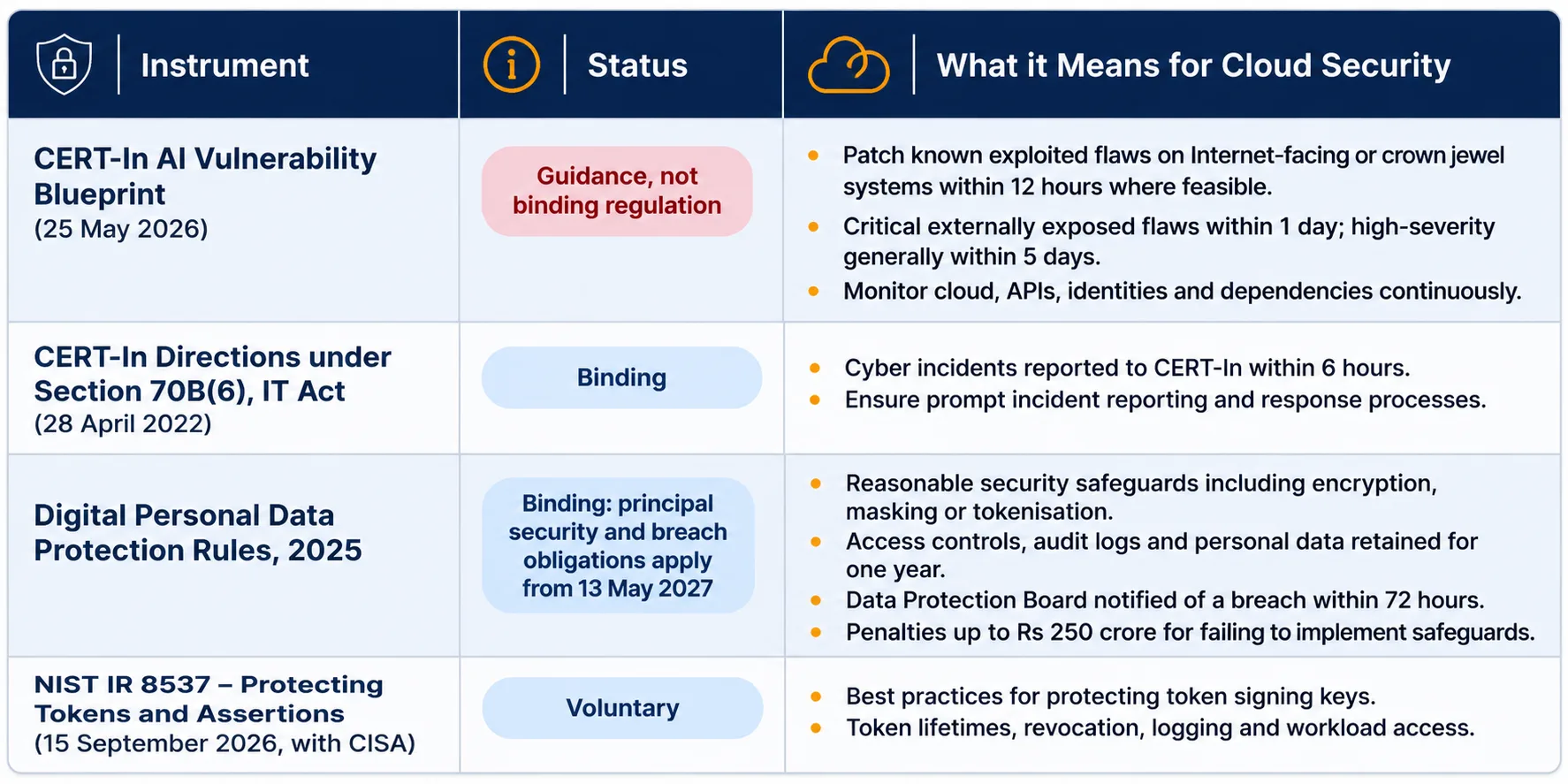
No single rule says "rotate your keys every 90 days". What exists is a growing set of expectations that, read together, make the practices in this article hard to avoid. Three instruments matter most to an Indian enterprise, and a fourth sets a useful benchmark.
What do these rules change in practice?
The CERT-In patching targets are the sharpest. A 12 hour window for a known exploited flaw on an exposed system is incompatible with a monthly patch cycle, and the Google Cloud data above shows why CERT-In set it that short. In our view, even as guidance it is the yardstick a regulator, auditor or board member is likely to reach for after an incident.
DPDP changes the cost of a credential leak. If a stolen key exposes personal data, the question after the breach will be whether you had reasonable safeguards, and unused access keys, missing access logs and no encryption are hard to defend. The one year log retention requirement also means identity and cloud audit logs need a retention plan now, not in 2027.
NIST IR 8587 is not binding in India, but it was written in response to a real case: forged tokens made with a single stolen commercial signing key were used to reach agency email, and more than 60,000 emails were taken from one agency. It extends the same protections to AI agents and workloads, which makes it a practical reference for how long tokens should live and how quickly you can revoke them.
What should enterprises do now to protect cloud infrastructure?
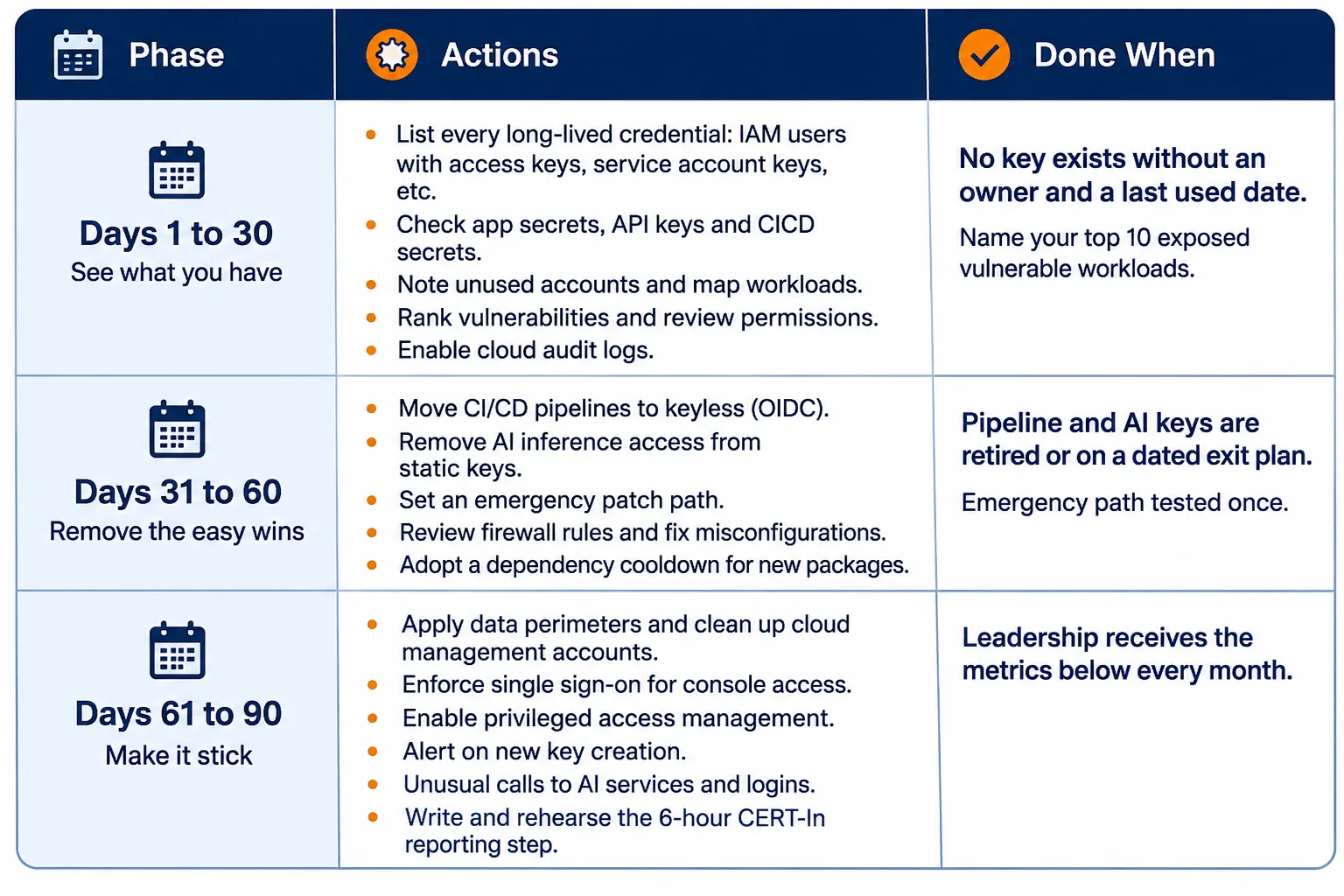
Start with credentials and exposure, not with a platform purchase. The sequence below is our recommended order of work, built from Datadog's own recommendations (short-lived workload identities, dependency cooldowns, data perimeters), Google Cloud's advice to block exploits at the edge while patches are applied, and the CERT-In timelines. It is a framework, not a standard, so adjust it to your estate.
Which numbers should the board actually see?
Four measures tell the story better than a raw vulnerability count: the median age of long-lived keys, the share of pipelines and workloads using short-lived identities, the time from disclosure to patch for exposed workloads (against the CERT-In 12 hour, 1 day and 5 day targets), and the number of AI services reachable with a static key. If those four trend the right way, the headline vulnerability count matters less. If they do not, no scan report will compensate.
How should teams decide what to fix first?
Ask three questions of every finding, in this order. Is the workload reachable from the internet? Is the flaw being exploited in the wild? What can the workload do if it is taken over, meaning which roles, keys and data does it hold? A medium severity flaw on an exposed workload with administrator rights often deserves attention before a critical one buried in an internal batch job.
What happens next for cloud security over the next two to five years?
One forecast, and then our own analysis, labelled as such.
Forecast. Gartner expects information security spending in India to reach about $3.4 billion in 2026, up 11.7% from $3.08 billion in 2025, against growth of 7.9% the year before. Security software is the largest and fastest growing segment, and managed security services is the fastest growing services subsegment at an estimated 15.1%. Gartner also calls identity threat detection and response a core priority. Budgets are moving toward the areas this article covers.
Our analysis, not a forecast from any cited source:
Patch windows will keep shrinking. If disclosure to exploitation is already measured in days, and vulnerability volumes keep rising, manual patching cannot be the primary defence for exposed workloads. Expect automated patching, virtual patching at the edge and reachability based prioritisation to become standard practice.
Static keys will turn into an audit finding. Cloud providers, security vendors and standards bodies are all pointing toward short-lived identity. AWS adoption of keyless pipelines shows the direction, and Azure and Google Cloud users have the most ground to cover.
Agent identity is the next gap. NIST applies its token protections to AI agents but says broader agent identity questions need further guidance. Enterprises deploying agents that call cloud APIs on their own will need an identity model for them before a standard tells them what it is.
DPDP will be the forcing date. With the principal obligations applying from 13 May 2027, the logging, access control and breach response work described here has a deadline attached.
There is an opportunity inside the risk. Teams that remove static secrets also remove a category of rotation tickets, shared key spreadsheets and offboarding worries. Keyless pipelines and workload identities are a security control, and they are also less work to run.
Where does NS3TechSolutions fit?
NS3TechSolutions, which published this article, works with enterprises on cloud security, cloud infrastructure security, vulnerability assessment, identity and access management, and managed security services including SOC operations. Those map directly onto the framework above.
Vulnerability assessment covers the first thirty days: finding exposed workloads and ranking findings by reachability, exploitation and privilege rather than score alone.
IAM work covers the credential inventory, the move from static keys to short-lived identities, single sign-on and privileged access controls.
Cloud infrastructure security reviews cover configuration, network exposure, data perimeters and the management account hygiene that audits tend to surface late.
Managed security services supply the continuous part: monitoring identity and cloud audit logs, alerting on new keys and unusual AI service use, and escalating exposed, known exploited flaws against the patching targets above.
For most organizations the sensible first step is small: a credential and exposure assessment of one cloud account, which produces the inventory and the ranked list the rest of the programme depends on. NS3TechSolutions can run that assessment, or help your own team design it.
Practical checklist: cloud security review for IT leaders
Copy this into your own tracker and assign owners.
We have a complete list of long-lived credentials across AWS, Azure and Google Cloud, each with an owner, age and last used date
Unused keys and service accounts have been disabled
No AI service (Gemini, Bedrock, Azure AI or other) is reached with an unmanaged static key
CI/CD pipelines authenticate with keyless (OIDC) or workload identity wherever the provider supports it
Console access runs through single sign-on, with privileged access management for admin roles
We know which workloads are internet-facing and which carry known exploited vulnerabilities
Exposed, known exploited flaws have a tested emergency patch or virtual patch path
A dependency cooldown policy exists for new package versions
Cloud audit and identity logs are centralised and retained for at least one year where personal data is involved
The cloud management account holds no workloads
A compromised key or token playbook exists and includes the 6 hour CERT-In reporting step
The board sees key age, keyless coverage, time to patch exposed workloads and static-key AI services every month
Frequently asked questions
Q. Why did cloud security vulnerabilities rise fourfold in 2026?
A. Datadog's State of Cloud Security 2026 found the median number of high or critical vulnerabilities per analysed cloud workload rose from 4 to about 16 between February and November 2026 (some coverage uses May as the starting month). Datadog ties the trend to the AI era and a growing volume of disclosed vulnerabilities in third-party libraries. The figure measures open library flaws in Datadog's customer base, not every cloud risk.
Q. Are long-lived credentials more dangerous than vulnerabilities?
A. They are often easier for an attacker to use, because a valid key needs no exploit and can look like normal activity. They are not more common as an entry point in every dataset: Google Cloud found vulnerability exploitation behind 44.5% of initial access in the second half of 2025 and weak or absent credentials behind 27.2%. Enterprises need to fix both, and the two problems feed each other because a compromised workload often yields stored keys.
Q. How fast should we patch exposed cloud workloads?
A. CERT-In's May 2026 blueprint suggests containing and patching known exploited vulnerabilities on internet-facing or crown jewel systems within 12 hours where feasible, critical externally exposed flaws within 1 day, and high severity flaws generally within 5 days. It is guidance, not binding regulation, but it is a sensible target for exposed workloads.
Q. How do we replace static keys without breaking pipelines?
A. Start from the inventory, not the migration. Disable keys with no recent use, then move one pipeline at a time to keyless (OIDC) or workload identity and keep a dated exit plan for any key that has to stay. Datadog reports that 54% of AWS organizations using GitHub Actions already rely only on keyless authentication, so the pattern is established, although Azure (5%) and Google Cloud (22%) are far behind.
Q. Does the DPDP Act require specific cloud security controls?
A. The DPDP Rules, 2025 require reasonable security safeguards, which include encryption, masking or tokenisation, access controls, monitoring of access logs and backups, along with one year retention of personal data and logs. Breaches must be reported to the Data Protection Board, with detailed information within 72 hours. The principal obligations apply from 13 May 2027, and penalties reach Rs 250 crore for failing to implement safeguards.
Q. How do we secure AI inference services in the cloud?
A. Treat them like any production data service. Give applications short-lived identities (IAM roles, managed identities or service accounts) instead of static API keys, restrict which workloads can call which models, log and alert on unusual usage, and inventory every AI service in use, including those teams adopted without approval. IBM found that 92% of organizations reporting an AI system incident lacked controls such as role-based access and multi-factor authentication.
Q. Is a managed security service worth it for cloud workloads?
A. It is worth considering if you cannot staff round the clock monitoring of identity and cloud audit logs, or cannot act within CERT-In style patch windows on your own. Gartner estimates managed security services as the fastest growing services segment in India in 2026, at 15.1%. Whatever you choose, write down who has authority to disable a key, isolate a workload or push an emergency patch, because that decision is where managed arrangements most often stall.
The takeaway: measure the doors, but manage the keys
A fourfold rise in vulnerabilities is a lagging signal. By the time it appears in a report, the exposure has already built up in your own estate, one dependency and one forgotten key at a time. The leading signals are quieter and more useful: how old your oldest credential is, how many workloads authenticate without a stored secret, and how many hours pass between a known exploited flaw being published and your exposed systems being fixed.
Organizations that track those three will not escape every incident, but they will find out sooner and lose less when one arrives. Organizations that only watch the vulnerability count will keep adding to a backlog they cannot clear, while a key from 2023 sits in a build system, still valid, still unowned.