Why Are Rising IT Costs Making Businesses Switch to Mac?
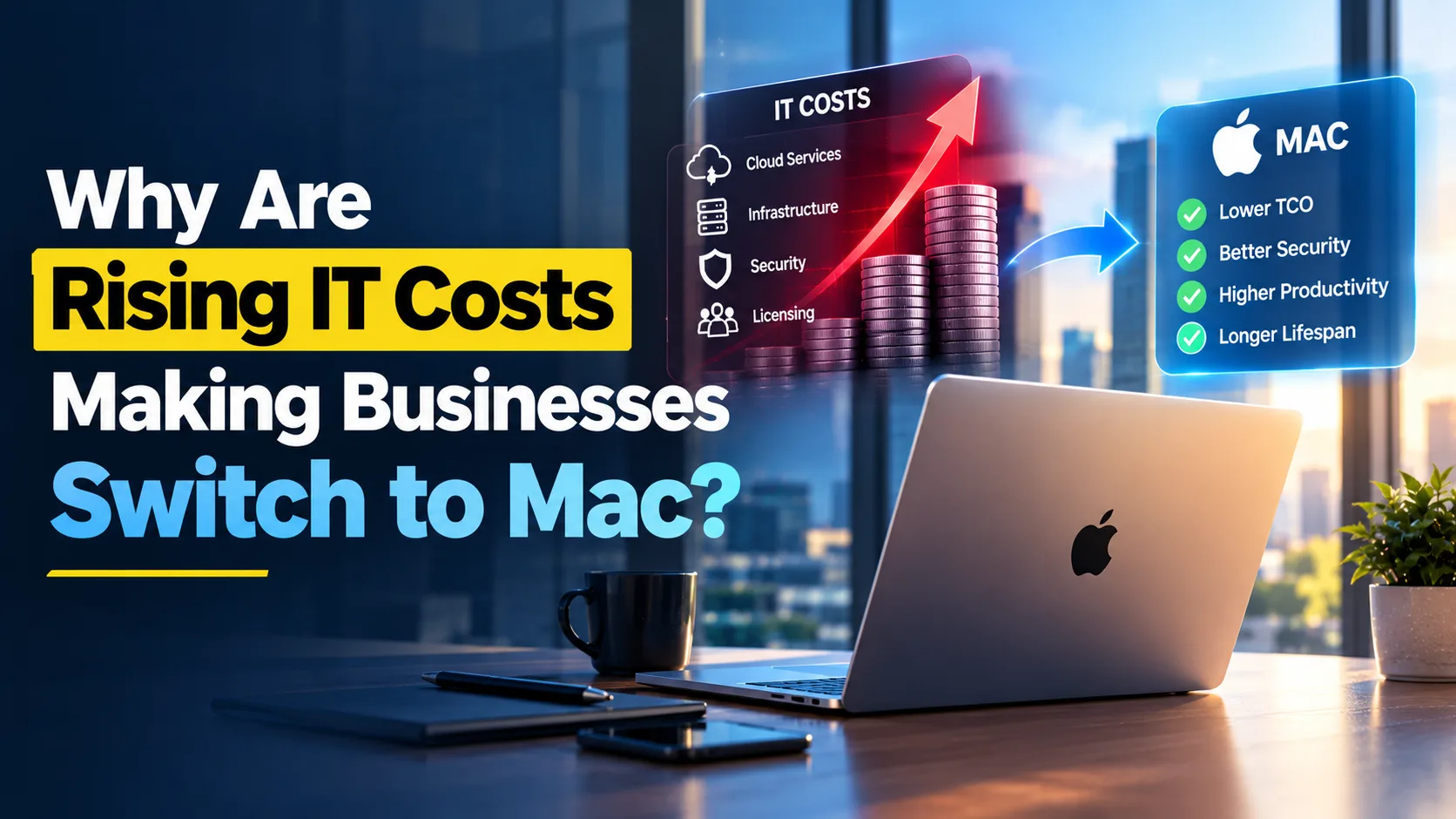
IDC reported on 8 July 2026 that worldwide PC shipments fell 4.9% year over year in the second quarter, to 68.2 million units. It was the first decline after nine straight quarters of growth. Lenovo shipped 2.1% fewer units, HP 9% fewer and Dell 5% fewer.
Apple went the other way. Press coverage of the IDC data puts Mac shipments at about 6.7 million units, up roughly 10%, which lifted Apple's share from 8.5% to 9.9%. Omdia counts differently and showed Apple nearer 7.3 million units with growth around 16%. The two firms disagree on the size of the jump, not its direction.
IDC links the decline largely to the memory shortage. AI data centres are absorbing DRAM and NAND capacity, and device makers are passing the cost on. IDC's Jitesh Ubrani described a market where units are falling but revenue is rising, because price increases are landing faster than demand is dropping. IDC does not expect the shortage to ease until early 2028 and says vendors are bracing for further price rises into 2027.
One caution before reading too much into the Mac numbers. These are shipments to all buyers, including consumers and schools, and the MacBook Neo launched in March 2026 as a low priced model. They show momentum, not corporate procurement alone.
The India picture is more nuanced. IDC India recorded Q2 2026 shipments of 3.9 million units, up 12.1%, and noted that commercial buying was shaped by forward purchasing ahead of expected price rises. It expects the commercial segment to be flattish in the second half of 2026. IDC India put Apple's Q2 growth at 89% year over year, but from a small base. IDC data shared with TechCrunch in March showed MacBooks at about 5.6% of India's notebook market in 2025, against roughly 11% to 12% globally and about 20% in the US, with 85% to 87% of Mac shipments in India going to consumers.
You may also see analyst forecasts of India PC shipments falling 7% to 8% in 2026 with device prices rising up to 35% (reported by Moneycontrol in March). That sits awkwardly beside a 12.1% Q2 gain, and IDC's own explanation is pull forward buying. Buyers rushed ahead of the price rises, which borrows demand from later quarters.
Four cost pressures landing on Windows fleets at once
1. Hardware: the memory squeeze
TrendForce forecast PC DRAM contract prices to rise 105% to 110% quarter over quarter in Q1 2026, which it described as a record. Lenovo told channel partners to expect price rises on select commercial devices from March 2026, according to a CRN report relayed by TrendForce. IDC analysis reported by TechRadar said Lenovo, Dell, HP, Acer and Asus had warned of 15% to 20% price rises from the second half of 2026, while IDC's own average price forecast for the year was lower, at 4% to 6% and up to 8% in a worse case, as relayed by a secondary outlet. The gap is partly about averages: analysts expect configurations with larger memory to take the sharpest increases.
HP added another wrinkle in late 2025, saying Microsoft certified AI PCs cost 5% to 10% more than regular machines and had reached a quarter of its quarterly PC sales.
2. The Windows 10 tail
Windows 10 reached end of support on 14 October 2025. Businesses that still need it can buy Extended Security Updates at $61 per device for the first year, $122 for the second and $244 for the third, which totals $427 per device. The scheme is cumulative, so an organisation that skipped year one pays for both years if it joins in year two. Year one coverage ends on 13 October 2026.
Nexthink estimated that about 121 million enterprise PCs would still be running Windows 10 on the deadline, a potential first year bill of $7.3 billion worldwide. Omdia's survey of channel partners found 18% expected customers to stay on Windows 10 past the deadline. HP and Dell executives said in late 2025 that smaller businesses were upgrading slowly and that many older PCs could not run Windows 11 at all. Those machines are exactly the ones that now have to be replaced at 2026 prices.
A simple illustration, using Microsoft's published rates: 1,000 Windows 10 devices still in service on 14 October cost $122,000 for year two of ESU alone (my arithmetic). That money buys time, not support. Microsoft does not include technical support in ESU.
3. Licensing: Microsoft 365 got dearer on 1 July
Microsoft's commercial price changes took effect on 1 July 2026. List prices per user per month moved as follows: Microsoft 365 E3 from $36 to $39 (8.3%), Microsoft 365 E5 from $57 to $60 (5.3%), Office 365 E3 from $23 to $26 (13%), Business Basic from $6 to $7 (16.7%), and Frontline F1 from $2.25 to $3 (33%). Microsoft 365 Business Premium stayed flat. One early trade report in December 2025 quoted higher figures for E3 and E5, so confirm the exact numbers with your licensing partner before budgeting.
The list price is only part of it. UC Today reported that Microsoft's removal of volume discounts in November 2025 stacks on top of the July increase, and for organisations on older discount agreements the real rise can approach 20%. For 500 Microsoft 365 or Office 365 E3 users, a $3 monthly rise adds $18,000 a year (my arithmetic).
Microsoft says it added features to justify the increase, including Defender for Office 365 Plan 1 in E3 and Intune Plan 2 and Remote Help in E3 and E5. That is real value if you use it and a plain price rise if you do not.
There is a point here that Mac enthusiasts tend to skip. Most Mac using businesses still run Microsoft 365. The July increase hits them too. Licensing pressure is a reason to review spend, not a reason to move platform.
4. Support and management labour
The fourth pressure is quieter. Every device carries a lifetime of tickets, patching, imaging and replacements, and that cost does not appear on the hardware quote. It is also where the Mac argument is strongest, so it deserves its own section.
Does the Mac total cost of ownership argument hold up?
The three most cited data points are these.
IBM launched an employee choice programme in 2015 and said it saved between $273 and $543 per Mac over a four year life compared with a PC. IBM also reported that 5% of Mac users contacted the help desk against 40% of PC users, and that only 5% of Mac issues needed an in person visit compared with 27% for PCs.
Cisco published an internal analysis in 2023 covering more than 130,000 employees across 99 countries. It found Macs between $148 and $395 less expensive over three years, depending on the model, and reported that 24% of PC users chose a Mac when offered the choice at refresh.
Forrester's Total Economic Impact study, commissioned by Apple, estimated average savings of $843 per Mac over three years.
These are serious sources, and they point the same way. They also carry limits that a careful reader should weigh.
First, funding. Forrester's study was commissioned by Apple, and much of the IBM material circulates through Jamf, which sells Apple device management software. That does not make the numbers wrong. It means they are not independent.
Second, maturity. IBM and Cisco run well automated Apple programmes with dedicated engineering. A 300 seat company without zero touch enrolment and a management platform should not expect the same result.
Third, age. IBM's programme began in 2015, before Apple Silicon. Practitioners now argue Apple Silicon has lengthened Mac life. Bradley Chambers, a long time Apple IT administrator writing for 9to5Mac, said he moved from a three year to a four year refresh plan and expects four to five years to become common. That is an informed opinion, not a measurement, and the column is sponsored by an Apple management vendor.
Fourth, assumptions. One IT services firm's public Mac vs PC calculator assumes the Mac costs about $324 more upfront, and that Mac management software and support cost more per year ($350 and $250 against $200 and $180 for a PC). It then recovers the gap through resale value (about $306 against $45 after three years), lower licence and security tooling spend, and an assumed productivity loss of 1% of salary for Mac against 2% for PC. That last line is an assumption, not a measurement, and it is the largest swing factor in the model. Check any calculator, including this one, for what it assumes about resale and productivity.
Fifth, repair. Macs usually need an authorised repairer and parts can cost more. Check service coverage in the cities where your staff sit before you commit.
My reading: the evidence supports a lifecycle cost advantage for well managed Mac fleets in roles where Mac is a good fit, and it does not support a blanket claim that Mac is cheaper than Windows.
Apple raised its prices too, and the MacBook Neo complicates the picture
Apple launched the MacBook Neo on 4 March 2026 at $599, the lowest price it has ever charged for a Mac laptop. On 25 June, citing the memory shortage, Apple raised prices across Mac and iPad. The Neo went to $699. The 512GB MacBook Air rose from $1,099 to $1,299, and the 1TB MacBook Pro from $1,699 to $1,999. By my arithmetic that is roughly 17% to 18% on those three models, which is in the same range PC makers warned about. IDC's Nabila Popal said the increases were larger than she had expected.
So has the price gap with Windows laptops narrowed? There is no reliable public comparison yet of equivalent business models after both sets of increases, and an honest answer is that nobody can say for certain. Price a like for like spec from your own supplier.
The Neo is a genuine option, and a genuine trap. It uses an A18 Pro chip from the iPhone line and ships with 8GB of memory. Jamf, which sells Apple management tools, has called it an entry point for Mac at scale. Chambers, for his part, argues that anyone planning a four year life should buy the proven MacBook Air rather than a first generation Neo, and that cutting base memory to save money upfront is a false economy. My view is that the Neo suits shared devices and roles that live in a browser and cloud apps, and does not suit developers, analysts or designers who run heavy local workloads.
Security and compliance: the cost that arrives late
Compliance changes the arithmetic for the Windows 10 remainder. India's Digital Personal Data Protection Rules were notified in November 2025, with the substantive obligations, including reasonable security safeguards, taking effect around 14 May 2027. Law firm summaries list encryption, access controls, monitoring, logging and backups among the expected safeguards, and one summary notes security logs should be kept for at least a year. My reading, which is not legal advice, is that holding personal data on an operating system that no longer receives security fixes will be hard to defend as a reasonable safeguard.
There is also a technical clock. One Australian IT services analysis notes that the Windows Production PCA 2011 certificate, which signs the Windows boot loader, expires in October 2026, and that Windows 10 machines outside ESU will not receive the replacement certificates. Verify this against Microsoft's own Secure Boot guidance before acting, but add it to the risk register.
Mac is not a security shortcut. Jamf's 2026 Security 360 report, drawing on more than 150,000 devices, says Mac market share grew 16.4% year over year in 2025 and that attackers are building Mac specific threats. Jamf Threat Labs added over 26,000 malware samples in 2025, and trojans make up more than half of Mac malware. Jamf sells Mac security, so read this as an informed vendor view. The practical point stands: a Mac fleet needs patching, endpoint detection and monitoring just like a Windows one.
Risks that rarely make the business case
Two platforms, one security team. A mixed fleet adds identity, patching, compliance reporting and SOC visibility work. Microsoft Intune can manage Macs alongside Windows devices, and the July 2026 bundle adds Intune Plan 2 to E3 and E5, so existing licences may already cover part of the tooling.
Application gaps. Windows only line of business clients, finance macros and legacy plugins decide who can move. Audit them before you pilot.
Resale assumptions. TCO models lean on Mac resale values of around 25% after three years. Confirm that buyback or resale channels actually exist for your volumes in India.
Supply concentration. IDC expects the biggest vendors, including Apple, Dell and Lenovo, to use their scale to secure memory and squeeze smaller rivals. Less competition tends to mean less pricing leverage for buyers.
Transition cost. Training, migration and a dip in productivity during the move are real, and they usually fall outside the hardware comparison.
Extended lifecycles cut both ways. Stretching refresh to four or five years offsets today's prices, but only if software support for older chips holds, on either platform.
What enterprises should do now
Settle the Windows 10 remainder first. Inventory every Windows 10 device by hardware eligibility for Windows 11. Pay for ESU only where retirement is scheduled inside the next twelve months, and treat $122 per device as a penalty rate for delay.
Segment the fleet by role. Sort users into three groups: roles with a strong Mac fit (creative, mobile development, executives, remote knowledge workers), roles that could go either way, and roles bound to Windows software. Move the first group only.
Build the cost model from your own data. Include hardware at current quotes, licences, management tooling, security tooling, support tickets per device per year, deployment time, repair costs, expected life, and realistic resale. Do not borrow productivity assumptions.
Run a quarter long pilot. Use a slice of seats, roughly 5% to 10% in an organisation of a few hundred users, with a control group. Track tickets per device, provisioning time, application blockers and user satisfaction.
Fix management and security before devices arrive. Mobile device management, automated enrolment, endpoint detection, patch service levels and SOC onboarding should be ready on day one.
Buy memory deliberately and review licences. Do not trim base memory to hit a unit price on either platform. On licensing, trimming unused seats is the fastest offset to the July increase, and a multi year agreement buys price certainty at the cost of flexibility.
What is likely to happen next
These are forecasts and my own analysis, not facts.
IDC expects the memory shortage to last into early 2028 and vendors to push further price rises into 2027, with a sharp slowdown in growth in the second half of 2026. A Gulf News report cites SK Hynix executives expecting tight memory conditions through 2030, which should be treated as a claim rather than a settled forecast.
Windows 10 ESU runs out in October 2028, after the third and most expensive year. Organisations still dependent on it will face a hard stop, not a gradual slope.
India's security safeguard obligations arrive in May 2027, which will pull endpoint patching and logging into audit scope.
Refresh cycles are likely to lengthen on both platforms, which favours vendors with long software support for older hardware.
Mixed fleets will become normal. Mac growth in Indian enterprises is likely to continue from a low base, but with 85% to 87% of Mac shipments in India going to consumers today, a sudden corporate wave looks unlikely.
Where NS3TechSolutions Fits in Helping Businesses Switch to Apple
Most of these decisions are infrastructure decisions wearing a hardware label. Adding Macs to a Windows environment affects identity, device management, network access, patching, endpoint security and the monitoring that sits behind them. This is where NS3TechSolutions supports businesses through IT infrastructure, enterprise networking, cybersecurity, cloud and managed services.
NS3TechSolutions also provides Apple products and business-ready Apple solutions for B2B organizations, helping enterprises procure, deploy and manage Mac devices as part of a secure and scalable IT environment.
Three areas usually matter most. The first is an endpoint cost and suitability assessment based on an organisation’s actual support tickets, software licences and device lifecycle costs rather than generic vendor estimates. The second is network and identity readiness, ensuring Mac and Windows devices authenticate, connect and receive updates without creating an unmanaged environment. The third is ongoing visibility through SOC and NOC operations, so security events and operational alerts from both Mac and Windows endpoints are monitored through a unified process.
The real value lies not only in selecting the right device platform, but in ensuring that the chosen environment remains secure, manageable and cost-effective over the long term. Whether an organisation standardises on Windows, Mac or a mixed environment, the objective should be the same: reliable infrastructure, strong security and simplified IT operations.
A practical checklist for your next endpoint review
Count Windows 10 devices and mark which can run Windows 11
Decide before 14 October which Windows 10 devices get ESU year two, and for how long
Get fresh quotes for hardware at current prices, with memory configurations stated
Check your Microsoft 365 renewal date, discount terms and unused seats
List Windows only applications and the users who depend on them
Segment users into strong Mac fit, either way, and Windows bound
Build a TCO sheet from your own ticket and refresh data
Confirm repair coverage and resale or buyback options in your cities
Make sure MDM, endpoint detection and SOC onboarding cover any new platform
Map endpoint patching and logging to your DPDP readiness plan
Set a pilot scope, a control group and success measures before purchase
Frequently asked questions
Q. Is Mac cheaper than Windows for business in 2026?
A. Not on sticker price. Apple raised Mac prices in June 2026 by roughly 17% to 18% on the models it highlighted. Studies by IBM, Cisco and Forrester suggest a lower lifecycle cost per Mac in well managed fleets, with savings of $148 to $543 per device depending on the study and period, but several were funded or relayed by Apple aligned companies. Use your own data.
Q. How much does Windows 10 ESU cost per device?
A. Microsoft charges $61 for year one, $122 for year two (starting 14 October 2026) and $244 for year three, a cumulative $427 per device. Joining in year two means paying for year one as well. ESU provides security updates only, with no new features and no technical support.
Q. How much have laptop prices risen because of the memory shortage?
A. Estimates vary by source and configuration. IDC's average 2026 price forecast was 4% to 6%, up to 8% in a worse case. PC makers warned of 15% to 20% rises from the second half of 2026, and some analyst reports cite 15% to 30%. Higher memory configurations are hit hardest.
Q. Should an enterprise buy the MacBook Neo?
A. For shared devices and browser and cloud based roles, it is worth piloting. For a four year production life, a practitioner view is that the MacBook Air carries less risk, and the Neo's base memory is 8GB. Match the model to the workload.
Q. Can Macs be managed alongside Windows PCs?
A. Yes. Microsoft Intune supports Mac management, and the July 2026 Microsoft 365 changes added Intune Plan 2 to E3 and E5. Specialist Apple management platforms are another route. Either way, plan enrolment, patching and security monitoring before rollout.
Q. Do Macs need endpoint security software?
A. Yes. Jamf's 2026 report documents growing Mac specific malware, including infostealers and trojans, and notes that growing Mac adoption makes the platform more attractive to attackers. Treat Macs as managed endpoints that feed your SOC.
Q. Is it worth considering Mac in India, given limited enterprise adoption?
A. It is worth a scoped pilot rather than a migration. Mac was about 5.6% of India's notebook market in 2025 and mostly consumer bought, so local service coverage, resale channels and skills may be thinner than in the US. Test those before scaling.
Q. When will PC prices come down?
A. IDC does not expect the memory shortage to ease until early 2028 and says vendors are bracing for more increases into 2027. Plan budgets on the assumption that prices stay high, and extend lifecycles only where software support allows.
The takeaway
The expensive mistake in 2026 is not picking the wrong operating system. It is treating endpoint spend as a string of unrelated renewals: an ESU invoice in October, a licence true up in the new year, a hardware quote that changes between approval and purchase order. Each looks defensible alone. Together they are a budget that has moved without a decision.
Mac is a credible answer for part of the fleet, and the evidence for its lifecycle economics is better than sceptics admit and weaker than advocates claim. The organisations that come out ahead will be the ones that segment by role, price on their own numbers, and secure whatever they choose.