When Should Enterprises Move From MPLS to SD-WAN?
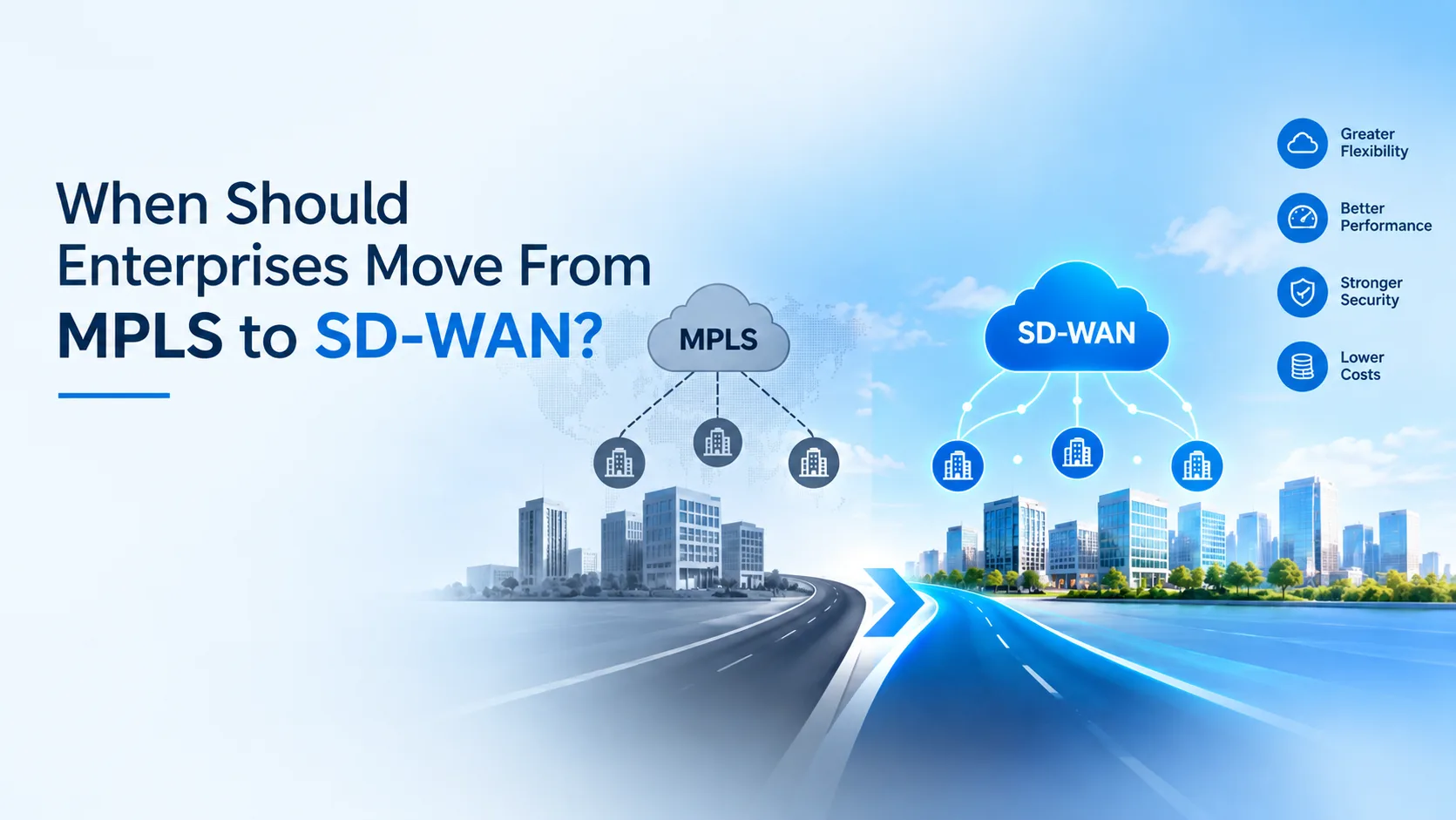
A mid-size manufacturer renews its MPLS contract every three years without much debate. Then one renewal cycle, the bill jumps. The vendor quotes six months to add a new branch circuit. The IT team realizes half its traffic is going to Microsoft 365 and Salesforce, not the data center MPLS was built to protect.
That is usually the moment the SD-WAN conversation starts. Not because a vendor pitched it. Because the network stopped matching how the business actually works.
The real question in 2026 is not "is SD-WAN better than MPLS." That debate is settled. The harder question is timing: when to move, and what breaks if the move is rushed.
When Should an Enterprise Move From MPLS to SD-WAN?
MPLS is not dead. Global MPLS-related market revenue sits between roughly $39 billion and $45 billion in 2026, still growing at 3.5% to 6.9% CAGR depending on the research firm.
That growth rate trails overall enterprise bandwidth demand by a wide margin.
Gartner expects 60% of new SD-WAN purchases to include single-vendor SASE by end of 2026, up from 15% in 2022.
A documented 27-site migration case cut WAN costs by 55% (details below).
The failures that matter are rarely technical. They come from skipped security redesign, skipped pilots, and rushed timelines.
Current State: The Numbers
MPLS is still large, but its share of new enterprise spend is shrinking.
The spread exists because firms define "MPLS market" differently (pure transport vs. managed MPLS vs. bundled IP VPN). The direction is the same across all of them: steady, modest growth, well behind cloud traffic growth.
Cloud has already changed where enterprise traffic goes:
~65% of enterprise workloads had shifted to public or hybrid cloud by 2025 (Mordor Intelligence).
Every branch that backhauls SaaS traffic through a central MPLS hub pays a latency tax for a routing decision built for a different era.
SD-WAN market-size estimates vary even more, from roughly $1.6 billion to $9.5 billion for 2026 across different firms. Treat any single number skeptically. The consistent trend across all sources: rising adoption, falling MPLS share of new spend, and consolidation toward SD-WAN bundled with security.
Signals It's Time to Move
Don't migrate on hype. Migrate evidence. Four signals worth tracking:
1. Cost and contract signals - Vendors claim SD-WAN saves 20% to 70% versus MPLS. MPLS providers argue those savings shrink once licensing; security and management costs are added. Both are partly right. Model it yourself at renewal time.
2. Traffic pattern signals - More than half of branch traffic going to SaaS or the public internet, not the data center? Hairpinning that traffic through MPLS adds latency for no security benefit.
3. Application and cloud signals - Recurring complaints about video call quality, slow SaaS load times, or inconsistent VPN performance at branches usually point to an outdated WAN design, not a bandwidth shortage.
4. Compliance and resilience signals - Rising incident-reporting and data-protection requirements often push organizations toward SD-WAN's centralized policy control, since it's easier to prove compliance from one control plane than from dozens of branch routers.
Any single signal is not a trigger. Two or three together usually is.
Case Study: 27 Sites, 55% Cost Reduction
A global shipping and maritime investment firm, advised by technology consultancy Pentima, ran more than 27 sites worldwide, including satellite offices and key shipping ports, on a legacy telco MPLS network. The published case (Aryaka) reports the network was too slow and too costly to extend to new locations as the business grew.
The company evaluated several providers, including telecom incumbents, before choosing a combination of core SD-WAN, last-mile services and private access, paired with third-party security.
Result: a 55% cost saving versus the prior MPLS pricing, plus a meaningful cut in the operational burden of managing connectivity across a globally distributed footprint.
A second published case, industrial manufacturer AL-KO, reported sharply reduced total cost of ownership, fewer outages, and new-site onboarding cut from months to days after replacing MPLS with SD-WAN.
Two caveats: these are vendor-published cases, not independently audited, so treat the percentages as directional, not guaranteed. And in both cases, the common factor wasn't the technology choice. It was planning security and last-mile connectivity as part of the migration from day one, not bolting it on afterward.
Where Migrations Go Wrong
The security gap at cutover MPLS backhauls everything through one inspection point. SD-WAN enables direct internet breakout at every branch, which breaks that model unless it's rebuilt deliberately. Research consistently flags this as the single most common oversight: teams carry over old security assumptions onto an architecture that no longer supports them.
The visibility gap Distributed, internet-facing WAN traffic is harder to monitor than a single chokepoint. Misconfigured edge devices and inconsistent firewall rules across sites are documented causes of post-migration exposure, not theoretical risks.
Vendor sprawl Bolting on point security products from multiple vendors instead of an integrated platform often costs more long-term and recreates the complexity SASE was built to remove.
Underestimated total cost Real TCO includes licensing, SASE subscriptions, monitoring tools, circuit upgrades, and management overhead, not just circuit pricing. Skip that modeling and your ROI timeline slips.
The skills gap SD-WAN policy management, application-aware routing and automation tooling require different skills than managing MPLS circuits. Teams that skip training under-use the platform or misconfigure it.
Pure IP's review of 100+ documented migrations found the same root causes repeating: insufficient business-driven planning, neglected security redesign, underestimated operational change, and skipped pilot testing. All four are planning failures, not technology failures. All four are avoidable.
What's Driving the Market Forward
Gartner's SD-WAN forecast: 16.8% CAGR through 2027, driven mainly by security integration, not raw bandwidth growth.
SASE market: projected to grow from $19.2 billion (2026) to $68.1 billion (2032), a ~28.8% CAGR (MarketsandMarkets).
AI-assisted network operations (predictive anomaly detection, automated path optimization) are moving from marketing language into real production features. Fully autonomous self-healing networks are not there yet.
The takeaway: buying standalone SD-WAN today without a credible security convergence roadmap likely means a second disruptive migration within a few years.
New Regulatory Guidelines to Know (2025-2026)
Compliance is now a network architecture decision, not just a security-tooling one.
Europe GDPR and the Digital Operational Resilience Act push enterprises toward stronger data sovereignty and network visibility, part of why European SD-WAN adoption has grown alongside regulatory tightening.
India
Amended Telecom Cybersecurity Rules (2025): extends reporting obligations to non-telecom entities using telecom identifiers, widening the compliance net to enterprises running their own SD-WAN infrastructure.
CERT-In six-hour incident reporting: mandatory under Section 70B of the IT Act. Centralized SD-WAN/SASE visibility is what makes hitting this window realistic across distributed sites.
DPDP Act, 2023: adds data-protection obligations around where and how data transits the network.
ITSAR certification: now required for IP routers and Wi-Fi CPE under the National Centre for Communication Security. The Pro Tem Security Certification Scheme (self-declared conformance) has been extended through a further two-year window from January 2026. Check vendor certification status before procuring SD-WAN edge hardware.
RBI guidance: for BFSI entities, continuous authentication and least-privilege access requirements map directly onto zero trust and SASE, not perimeter-based MPLS security.
Migration Checklist
Audit current traffic and application dependencies
Identify sites where MPLS should stay (latency, availability, regulatory need)
Redesign branch-level security inspection before finalizing topology
Pick a platform with a credible SASE/security roadmap
Model full TCO, not just circuit pricing; verify vendor savings claims yourself
Confirm vendor/hardware certification (e.g., ITSAR in India)
Pilot at representative sites under real traffic conditions
Train network and security teams before full rollout
Phase the rollout with clear rollback criteria per stage
Align timeline with data-protection and incident-reporting deadlines
Confirm full visibility across all sites before decommissioning MPLS
How NS3TechSolutions Helps Enterprises Migrate From MPLS to SD-WAN
Across enterprise networking, managed services and SOC/NOC engagements, the pattern repeats: the technology choice is rarely where projects fail. Sequencing, security redesign and operational readiness decide whether an enterprise gets the outcome the 27-site case above shows is possible, or inherits new risk instead.
NS3 starts with a traffic and application audit before any architecture decision, treats security redesign as a parallel workstream rather than an afterthought, and runs migrations as phased, piloted rollouts rather than single-event cutovers. For enterprises figuring out how much MPLS to keep, how to meet India's evolving telecom certification and data-protection rules, or how to build a WAN that can absorb SASE convergence without a second migration later, that is where the risk actually gets managed.
FAQ
Q. Is MPLS dead in 2026?
A. No. It's a $39B-$45B market still growing at 3.5%-6.9% CAGR, just slower than overall bandwidth demand. It still makes sense at sites with poor internet or strict latency/regulatory needs.
Q. Does SD-WAN always cost less than MPLS?
A. Not automatically. Vendors cite 20%-70% savings; the 27-site case above landed at 55%. But full TCO, not just circuit pricing, decides the real number.
Q. What's the biggest migration risk?
A. Security gaps from enabling branch-level internet breakout without redesigning inspection and monitoring to match. The most cited cause of post-migration exposure.
Q. How long does migration take?
A. Varies by size and site count. Phased, piloted rollouts consistently beat single-event cutovers on outcomes.
Q. SD-WAN vs. SASE, what's the difference?
A. SD-WAN: intelligent routing across WAN links. SASE: SD-WAN plus cloud-delivered security (ZTNA, secure web gateway, CASB) in one platform.
Q. What's new on India's regulatory side?
A. Amended Telecom Cybersecurity Rules, CERT-In's 6-hour reporting mandate, DPDP Act obligations, and ITSAR certification for network equipment, with the Pro Tem scheme extended through 2026.
Q. Can a migration be reversed if it goes wrong?
A. Much easier with a phased rollout and defined rollback criteria per stage than with a single full cutover.
Conclusion
The enterprises that get this right treat MPLS to SD-WAN migration as a security and operations project with a networking component, not the other way round. The savings are real when it's planned correctly, as the 27-site case shows. What separates success from failure is whether security gets redesigned, pilots get run, compliance gets checked, teams get trained, and the rollout gets phased, with the same discipline applied to any change touching every branch and every byte of business-critical traffic at once.