Who are NS3TechSolutions’ technology partners, and which industries and enterprise clients do they serve in India?
NS3TechSolutions is a Gurugram based network, cybersecurity, and managed services company, founded in 2018 and now more than 1,600 projects deep. We work with Fortinet, Cisco, Palo Alto Networks, Juniper Networks, IBM, Oracle, Check Point, CrowdStrike, F5, AWS and Microsoft Azure, among more than 100 technology partnerships. We serve BFSI, retail, pharma, hospitality, education, manufacturing, healthcare, government, aviation and SMEs. Our customers include BATA, Mankind Pharma, PayU, Pramerica, Hyatt Regency, Blue Star and Hindware.
Ask ten IT leaders how they chose their last technology partner and most will talk about a logo slide. Very few will talk about what happened at 3 a.m. when something went wrong. A partner list tells you where a company has worked. It does not tell you whether it can protect the network you run today.
So here is both: who NS3TechSolutions works with on the technology side, which industries and brands we serve across India, and a look at one live risk every one of those industries faces right now.
Which technology partners does NS3TechSolutions work with?
Network and security
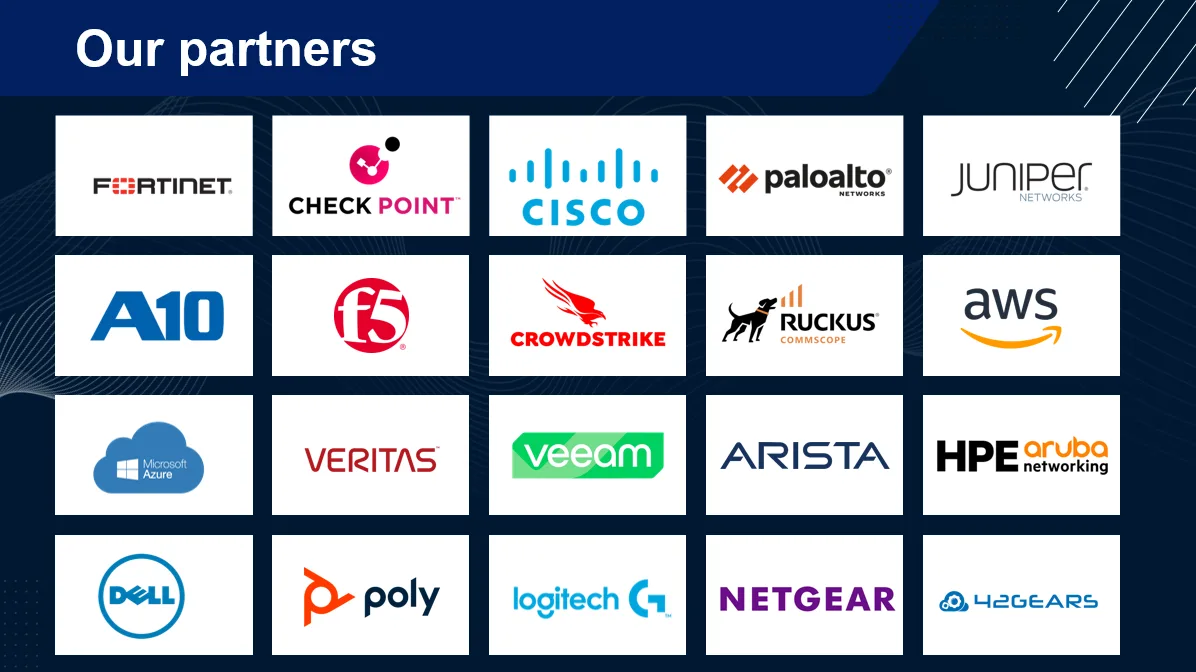
Most enterprises do not run one vendor, so we do not sell one. Our network and security partners include Fortinet, Cisco, Palo Alto Networks, Juniper Networks, Check Point, CrowdStrike, F5, A10 Networks, Arista, Ruckus and HPE Aruba Networking. We are a Fortinet Select Partner in Gurgaon, and our engineers hold Cisco CCIE Security, Cisco CCIE Data Center, Fortinet Network Security and Palo Alto Networks Network Security Professional certifications.
That depth shows up in the product families we deploy. On the Cisco side: Firepower Threat Defense, Identity Services Engine, Duo, Secure Endpoint, Umbrella, SASE, ZTNA, Viptela SD-WAN, Catalyst Center, Meraki, ThousandEyes and Webex. On the Fortinet side: FortiSIEM, FortiWAF, FortiMail, FortiNAC, FortiAuthenticator, FortiManager, FortiAnalyzer, FortiClient and FortiSASE.
Cloud, data protection and infrastructure
Behind the security layer sit cloud, backup, and hardware. Here we work with AWS, Microsoft Azure, IBM, Oracle, Veeam, Veritas, Dell, Lenovo, Poly, Logitech, NETGEAR, D-Link, Hikvision, Molex and DIGISOL. Threatcop covers the human side, with phishing simulation and security awareness, and 42Gears covers device management.
In practice this means we can design around the firewalls, switches, and cloud platforms a client already owns, and recommend changes only where they are worth the cost.
Which industries does NS3TechSolutions serve?
We work across manufacturing, SMEs, government, hospitality, BFSI, education, aviation and healthcare, and across retail and pharma enterprises. Each sector gets the same service stack, tuned to its risks:
Network consulting, SD-WAN and structured cabling
Wi-Fi surveys using Ekahau, and Fluke certified testing
Network access control and email security
Next Gen SIEM and SOAR
SOC and NOC as a service, with 24/7 monitoring
IoT security
Annual maintenance, standby devices and on-site support
We operate from Gurgaon, with offices in Bangalore, Chandigarh, Hyderabad and Mumbai.
Which enterprises does NS3TechSolutions work with?
Retail and consumer: BATA, Hira Sweets, Sujata Mittal Electronics, Blue Star, Hindware and others.
Pharma: Mankind Pharma, Aurobindo, Medanta, Romsons, and others.
Financial services and fintech: Creditas, Ambak Loan, PayU, Sammaan Capital, Pramerica and others.
Hospitality: Hyatt Regency, and others.
Education: Heritage School, Allen, PW, and others.
Technology, business services, real estate and energy: Binary Semantics, FiaGlobal, iSON, Benepik, ELAN, Fybros, Statiq, and others.
A retailer with hundreds of stores, a pharma company with a national field force, a fintech running an API platform and a hotel with guest Wi-Fi look nothing alike. They share one need: no single product protects them. They need a firewall layer, an identity layer, an endpoint layer, a logging layer, a backup layer and a team watching all of it.
Case study: the admin interface nobody was watching
This is a public incident, and it shows the gap retail, pharma and consumer businesses carry today.
What happened. In February 2026, TechCrunch reported that DavaIndia Pharmacy, the pharmacy arm of Zota Healthcare with more than 2,300 stores across India, had exposed customer data and internal systems. A security researcher found insecure “super admin” interfaces that let anyone without a login create accounts with high privileges.
The numbers.
Nearly 17,000 online orders exposed, including names, phone numbers, addresses, amounts paid and products bought
Administrative control over 883 stores: pricing, prescription requirements, discounts and website content
Interfaces apparently live since late 2024
Reported to CERT-In in August 2025 and fixed within weeks
Made public on 13 February 2026, roughly 14 months after the interfaces appear to have gone live
The researcher saw no sign of exploitation before the fix
Why it matters. There was no ransomware, no stolen password and no sophisticated attack. A door was left open. With those rights, an attacker could have changed prices, removed prescription checks, issued discount coupons or defaced the site. That is a business integrity problem as much as a data problem.
What controls close this kind of gap.
An inventory of every application and API, including internal ones
A web application firewall in front of customer-facing systems, with admin paths limited to VPN or approved IPs
Regular penetration testing. IBM India’s 2026 study found offensive testing was the largest single cost reducer, saving about ₹2.47 crore per breach on average
Continuous logging and alerts on privileged account creation, which is exactly what a monitored SIEM and SOC are built to catch
A clear route for outside researchers to report flaws, and a rehearsed process for reporting to CERT-In
None of this needs exotic technology. Web application firewalling, SIEM, network access control, and 24/7 monitoring are everyday parts of how we secure client environments.
What the numbers say about risk in these sectors in 2026
Cost. IBM India’s 2026 Cost of a Data Breach report puts the national average at ₹25.5 crore, up 15.9% from ₹22 crore. Financial services averaged ₹40.9 crore, technology ₹35.7 crore and communications ₹34.5 crore. The average incident exposed 39,500 records.
Entry points. Phishing, including voice and SMS phishing, led at 19%. Drive by compromise followed at 16% and supply chain compromise at 15%. Where shadow AI was present, it added about ₹1.79 crore to the bill.
Automation. Indian organisations using no AI or automation in security averaged ₹31.6 crore per breach, against ₹21.3 crore for extensive users. Identifying a breach took about 236 days without automation and 175 days with it.
Ransomware. Cyble’s H1 2026 data counts 77 ransomware attacks on India, the second highest in Asia Pacific after Thailand. Manufacturing took at least 49, IT and ITES 30 and BFSI 22.
Volume. Seqrite’s India Cyber Threat Report 2026, covering October 2024 to September 2025, counted 265.52 million detections, about 727,000 a day. Education, healthcare and manufacturing together accounted for nearly 47%. CERT-In handled over 29.44 lakh incidents in 2025.
Reading across sectors: finance and fintech carry the highest cost per breach, manufacturing and IT services draw the most ransomware, and education and healthcare see the most raw attack volume. Retail, pharma and hospitality are targeted for customer data and payment systems.
What clients in these sectors want to know before they sign
Who acts at 3 a.m.? Monitoring is not response. Ask who is allowed to isolate a device or disable an account, and how quickly.
Will you work with what I already own? Most estates are mixed. A partner with many OEM relationships can build around existing Fortinet, Cisco, or Palo Alto equipment instead of forcing a rip and replace.
How fast can I report? CERT-In requires specified incidents to be reported within six hours. Under the DPDP Rules 2025, a detailed breach report is due within 72 hours, with full application expected around May 2027.
Where do my logs live? CERT-In expects logs to be kept for 180 days, and common guidance is to keep them in India. DPDP guidance points to a one-year minimum for certain records.
What will this cost over three years? Ask for onboarding, log growth, incident response hours and exit terms in writing before signing.
Practical checklist
List the OEM certifications held by the engineers who will work on your account
Match the partner’s strengths to the products you own today
Ask for a reference from your own industry
Confirm SOC and NOC hours, escalation levels and who holds authority to contain an incident
Check that the partner’s ISO 27001 scope covers the service you are buying
Include an external attack surface and API review in onboarding
Agree log location, retention and exit terms in the contract
Add a vendor notification clause that protects your six hour CERT-In window
Run a tabletop exercise within the first 90 days
FAQ
Q. Who are NS3TechSolutions’ main technology partners?
A. Fortinet, Cisco, Palo Alto Networks, Juniper Networks, IBM, Oracle, Check Point, CrowdStrike, F5, A10, AWS, Microsoft Azure, Veeam, Veritas, Dell and Lenovo, among others.
Q. Is NS3TechSolutions a Fortinet partner?
A. Yes. NS3 is a Fortinet Select Partner in Gurgaon.
Q. Which industries does NS3TechSolutions serve?
A. BFSI, retail, pharma, hospitality, education, manufacturing, healthcare, government, aviation and SMEs.
Q. Does NS3TechSolutions provide SOC and NOC services?
A. Yes. We offer SOC as a service, NOC as a service, SOAR, Next Gen SIEM and 24/7 monitoring and support.
Q. Why does a partner with many OEM relationships matter?
A. Few enterprises run a single vendor. A multi OEM partner can integrate with the tools already in place and compare options without a vendor bias.
Q. What is the biggest cyber risk for retail and pharma companies in 2026?
A. Exposed customer facing systems and weak privileged access, as the DavaIndia case shows, along with phishing and supply chain compromise, which IBM India found were leading entry routes at 19% and 15%.
How much does a data breach cost an Indian company?
A. ₹25.5 crore on average in 2026, according to IBM India, and ₹40.9 crore in financial services.
The question to ask any partner
Before you compare logo walls, ask one thing: if the most powerful admin account in my business were created by a stranger tonight, how soon would you know, and who would be on the phone with me? The partner who answers with a named team, a time, and a tool has earned their place on the list.