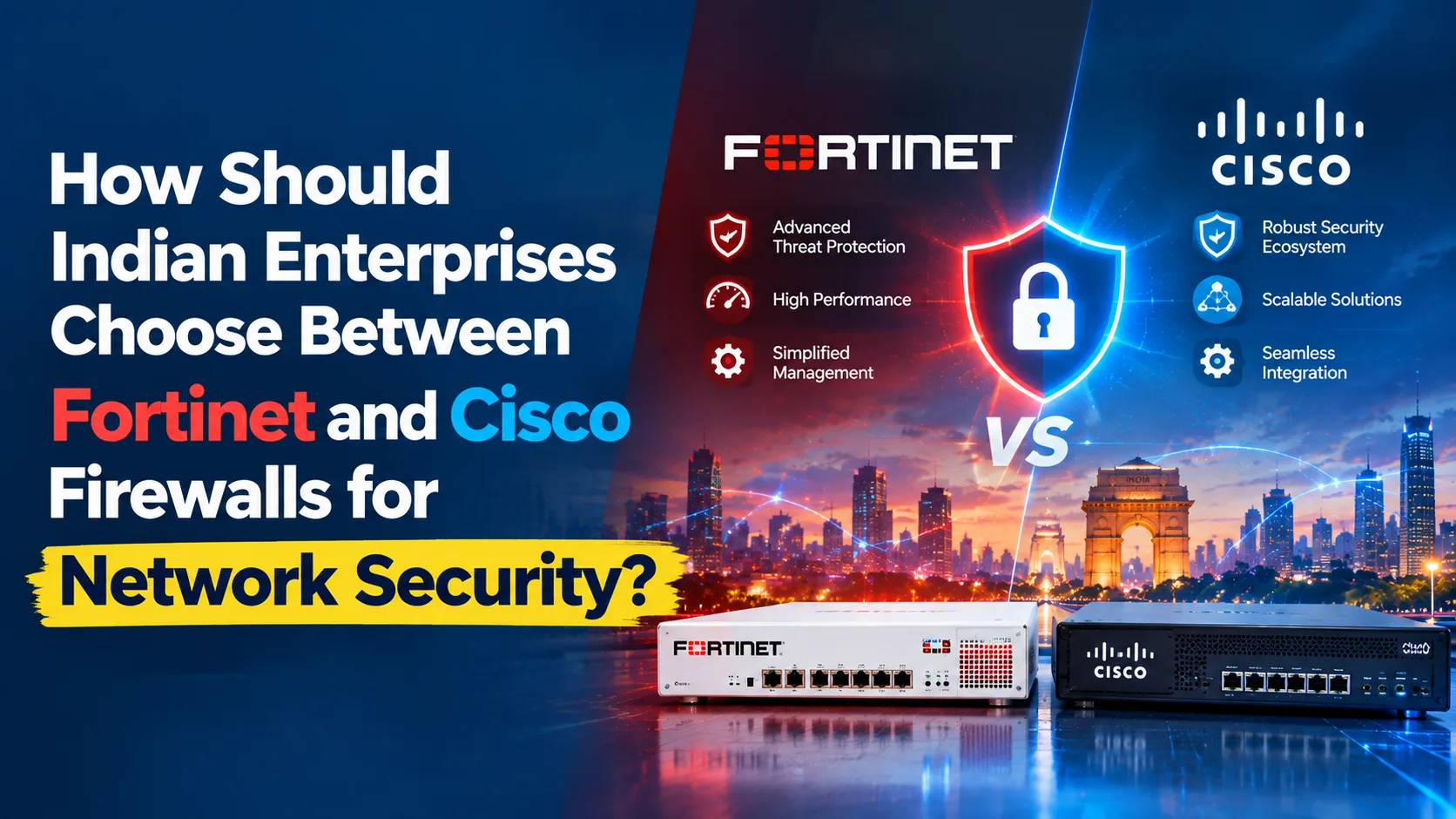
How Should Indian Enterprises Choose Between Fortinet and Cisco Firewalls for Network Security?
On 9 September 2026, CISA added two firewall related flaws to its Known Exploited Vulnerabilities catalog on the same day: a maximum severity authentication bypass in Cisco's Secure Firewall Management Center and a Fortinet FortiOS flaw. Federal agencies were given until 12 September to fix both. Two vendors, one day, both exploited in the wild.
That is the backdrop for any Indian enterprise choosing between Fortinet and Cisco firewalls right now. Most comparisons still read like spec sheets: throughput, port counts, licence tiers. Those numbers matter. But the incidents of the past eighteen months point to a harder question. Which platform can your team patch, monitor and audit fast enough, inside your own regulatory setting?
Fortinet vs Cisco Firewall in India: The Key Differences
There is no universal winner, and anyone who tells you otherwise is selling something. As analysis rather than fact: Fortinet tends to suit enterprises that want strong price performance, many branches, SD-WAN and security on one operating system, plant networks and sovereign style deployments. Cisco tends to suit enterprises whose switching, identity and segmentation already run on Cisco, where one management model across that estate is worth more than the last bit of price performance.
On analyst opinion, Fortinet leads on execution and Cisco scores well on vision. On exploit history, neither vendor has an edge you should bank. The decision that matters most is operational: how quickly you can patch, how exposed your management plane is, and whether your logs land where Indian rules expect them.
Where the market stands in late 2026
Fortinet has real momentum. For the quarter ended 30 June 2026 it reported billings of USD 2.37 billion, up 33%, and revenue of USD 2.05 billion, up 26%, crediting strong FortiGate unit growth and higher selling prices as customers moved to faster models. The company says it holds 55% of firewall units shipped. Bloomberg Research estimates, as cited by Nasdaq, put it above 50% of units but only second or third by revenue. The gap is worth understanding. Units include a very large number of small branch boxes, so revenue share is the better proxy for large enterprise spend (my inference).
Gartner introduced a Magic Quadrant for Hybrid Mesh Firewall in August 2025. Fortinet, Palo Alto Networks and Check Point were Leaders, with Fortinet placed highest for Ability to Execute. Cisco was a Visionary. Gartner said Cisco was rarely seen on standalone hybrid mesh and cloud firewall shortlists, yet trade press reported Cisco ranked second on completeness of vision, behind Palo Alto Networks. Gartner also marked Fortinet down for the number and severity of its vulnerabilities, limited roadmap visibility and the need to use several interfaces. In the 2026 edition, dated 7 September, Fortinet reports Leader status and the highest Ability to Execute for a second year. I could not confirm Cisco's 2026 placement from a primary source, so check the report before quoting it. Treat all of this as Gartner opinion, not measurement.
Cisco has not stood still. At Cisco Live in June 2026 it announced Cloud Control as a single operations platform, Live Protect for compensating controls against unpatched vulnerabilities, and a Hybrid Mesh Firewall release that extends policy across Cisco and third party firewalls. It also continues to push Hypershield, built on eBPF technology from Isovalent, and its 6100 Series, which Cisco says reaches up to 700 Gbps of firewall throughput (a vendor figure). Fortinet answered in July with the FortiGate 1200G and what it calls the SASE firewall, combining local enforcement with cloud security, along with an on premises sovereign SASE option.
On size, IMARC puts India's network security market at about USD 1.5 billion in 2025, and an earlier edition of its research forecast growth of 14.5% a year through 2033. Other estimates are lower, likely because definitions of network security differ, so use any single figure as direction, not precision.
Why this choice carries more risk than it did three years ago
Firewalls are edge devices, and edge devices are where attackers now start. Verizon's 2025 Data Breach Investigations Report found that VPN and edge device flaws made up 22% of vulnerability exploitation breaches, up from 3% the year before. Only about 54% of those flaws were fully remediated, and the median fix took 32 days. Summaries of the same report note that mass exploitation of edge flaws often began on the day of disclosure. Put those together and the realistic patch window is shorter than most change advisory cycles (my analysis).
Indian numbers point the same way. Government data reported in the press shows CERT-In handled about 2.944 million incidents in 2025, against roughly 2.04 million in 2024. Check Point's India report uses a different 2024 base of 2.27 million, which reflects differences in source and counting method. Check Point also found Indian organisations faced an average of 2,011 attacks a week in 2025. IBM's 2026 Cost of a Data Breach report puts the average Indian breach at Rs 25.5 crore, up 15.9%, with financial services at Rs 40.9 crore. IBM also found 26% of malicious breaches in India were AI generated, and that organisations with no security AI or automation paid Rs 31.6 crore per breach against Rs 21.3 crore for heavy users.
What that means for a firewall decision is simple. A choice that adds a few days to your patch cycle, or leaves a management console reachable from a routable address, shows up on the cost line.
What went wrong at both vendors
Cisco. In September 2025 CISA issued Emergency Directive 25-03 after a campaign linked to the ArcaneDoor actor hit Cisco ASA and Firepower devices. Federal agencies had to inventory devices, hunt for compromise and patch on a very short clock. Attackers chained CVE-2025-20333 and CVE-2025-20362 and, according to security vendor analysis, tampered with device firmware so the foothold could survive reboots. In 2026 the problem moved to the management layer. CVE-2026-20079, an authentication bypass in Secure Firewall Management Center with a CVSS score of 10.0, was disclosed and patched in March, then confirmed as exploited later in the year. Cisco Talos tracked three intrusion clusters, including state sponsored and ransomware linked actors. It was the third FMC flaw added to CISA's catalog in 2026, after CVE-2026-20316 and CVE-2026-20131.
Fortinet. In January 2026 Fortinet disclosed CVE-2026-24858, a FortiCloud single sign on authentication bypass rated CVSS 9.4 and exploited in the wild. Fortinet temporarily switched off FortiCloud SSO on 26 January as an emergency step. In September CISA added CVE-2025-25249, a heap overflow in FortiOS, FortiSwitchManager and FortiSASE, to the catalog. Fortinet shipped fixes months earlier, so attackers were exploiting appliances that hadn't been updated. One third party tracker counted 26 Fortinet CVEs on the CISA catalog as of July 2026, 13 of them tied to ransomware use.
How to read this. Three observations, mostly my analysis. First, both stories involve the control plane, the management or authentication layer, not just the packet path. Second, both involved fixes that existed before exploitation peaked, which makes patch discipline the deciding variable. Third, raw catalog counts are a poor scorecard. They depend on install base, years in market and how many products a vendor ships, and I could not find a like for like Cisco count from a primary source. GreyNoise data for the second half of 2025 shows attackers pound every vendor: 16.7 million sessions against Palo Alto GlobalProtect, 3.0 million against Cisco SSL VPN and 1.6 million against Fortinet SSL VPN. Scan volume isn't market share, but it shows no brand is a shield.
Fortinet vs Cisco on the dimensions that decide the outcome
The table below is a fit guide drawn from vendor positioning, analyst commentary and the evidence above. It is not a ranking.
Commercials deserve their own paragraph. Licence structures differ between the vendors, and reseller comparisons claim large five year cost gaps, in one case as high as 45%. Treat those as marketing until proven. Gaps swing widely with bundle choices, management platforms, SD-WAN licences and renewal terms. Ask each vendor for a five year total covering hardware, subscriptions, management, support and spares, plus renewal price caps.
A mixed estate is also legitimate. Gartner forecast in earlier network firewall research that more than 60% of organisations would run multiple firewall deployments by 2026. A common pattern is Fortinet at branches and plants and Cisco in a data centre built on Cisco fabrics. The price is two skill sets and two patch streams, and Cisco's new third party policy reach should be verified before it justifies the mix.
What Indian regulation changes about the decision
CERT-In Directions, April 2022. Covered entities must report specified incidents within six hours of noticing them, keep ICT logs for a rolling 180 days inside India and synchronise clocks to NIC or NPL time sources. For firewalls that means log export to storage kept in India, reliable time sync and incident playbooks that can meet a six hour clock.
DPDP Rules 2025. Notified on 13 November 2025, with most substantive obligations starting after 18 months, which is around May 2027. Rule 6 requires reasonable security safeguards, including keeping logs and associated data for at least one year. Sizing log retention for a year rather than 180 days covers both regimes.
SEBI CSCRF. Issued 20 August 2024 and clarified in August 2025. Under the principle of exclusivity, shared network infrastructure can fall inside SEBI's audit scope if no primary regulator already covers it. Capital market entities should map firewalls to that scope early.
CISA BOD 26-02, February 2026. It binds US federal agencies, not Indian firms, but CISA urged all organisations to follow it. It sets an inventory of end of support edge devices within 3 months, removal of those already unsupported within 12 months, replacement of the rest within 18 months and continuous discovery within 24 months. It is a sensible benchmark for your own firewall lifecycle policy.
The practical effect: the best firewall on paper is the wrong one if it cannot keep a year of logs in India, cannot be time synchronised, or sits past its support date in a branch nobody visits.
A decision framework you can run in six weeks
Inventory the edge. List every firewall by model, software version, support end date and management exposure. Fortinet itself estimates around 650,000 of its own units reach end of service by late 2026, so some of your devices may already be close.
Write the architecture before the RFP. Sites, plants, data centres, cloud, remote access and any SASE plan. Vendors answer the question you ask.
Score with weights. A starting point, which you should adjust: security operations and patchability 25%, fit with existing estate 20%, five year cost 20%, compliance and data residency 15%, local support depth 10%, roadmap and ecosystem 10%.
Pilot with hostile questions. Is the management interface reachable from the internet by default? How fast does a hotfix arrive and install? Can logs stream to Indian storage? What happens to failover under load?
Price five years. Appliances, licences, management platform, SD-WAN, support, spares, training and renewal caps.
Contract for security. Patch notification commitments, end of support dates in writing, India based support response times and hardware replacement terms.
Then harden whichever platform you pick. Keep management interfaces off the internet, put them on a dedicated network with multi factor authentication, disable features you do not use (for example FortiCloud SSO where it is not needed), and treat any entry on CISA's catalog affecting your platform as a days not weeks fix.
What to expect over the next two to five years
These are forecasts and informed judgement, not facts.
Hybrid mesh becomes the buying frame. Gartner now has a dedicated report, and vendors are extending policy to cloud and, in Cisco's case, to third party firewalls.
AI will run more of the console. Cisco's AgenticOps for Security aims to analyse firewall data and remediate issues on its own. That is useful, but it also makes the management plane a more valuable target (my inference).
Quantum readiness enters RFPs. Fortinet has emphasised early post quantum cryptography support and Cisco announced quantum ready protection across firewall and SD-WAN. Start a cryptographic inventory now.
Sovereignty pressure grows. As DPDP obligations bite around 2027, expect more questions on where logs and telemetry live.
Lifecycle rules harden. Directives such as BOD 26-02 tend to become procurement norms, and Indian auditors often borrow US benchmarks (my inference).
How NS3TechSolutions fits into this decision
NS3 TechSolutions works across IT infrastructure, enterprise networking and cybersecurity, and runs managed services including SOC and NOC. In a firewall decision that maps to four jobs. First, assessing your current estate and lifecycle exposure. Second, building the architecture and scoring model above so the shortlist reflects your environment rather than a vendor deck. Third, deployment and migration, including policy conversion and cutover planning. Fourth, operations: tracking vendor advisories against the CISA catalog, keeping logs aligned with CERT-In and DPDP, and monitoring through SOC and NOC.
The value sits mostly in the unglamorous parts. Firewall estates rarely fail on purchase day. They fail in month fourteen, when a hotfix is waiting in someone's queue.
Practical checklist
Save this and use it in your next review meeting.
Do we have a current inventory of every firewall with model, software version and support end date?
Is any management interface, SSO feature or admin portal reachable from the internet?
Can we apply a critical hotfix within days, including out of hours?
Do we subscribe to vendor advisories and track CISA's catalog for our platforms?
Do logs reach storage inside India, with clocks synchronised, for at least 180 days and ideally a year?
Have we tested a six hour incident reporting drill?
Have we priced five years, including management, SD-WAN, support and renewal caps?
Is there written commitment on India based support response and hardware replacement?
Do we know which devices reach end of support in the next 24 months?
Have we scored vendors on weighted criteria and recorded why?
FAQ
Q. Is Fortinet or Cisco better for an Indian enterprise firewall?
A. Neither wins universally. Fortinet usually fits price sensitive, branch heavy, OT and SD-WAN led estates. Cisco usually fits estates already built on Cisco networking and identity. Decide with a weighted scorecard, a pilot and a five year quote rather than brand preference.
Q. Which vendor has had more exploited vulnerabilities?
A. Raw counts are not like for like. Cisco had exploited flaws in ASA and Firepower devices (2025) and in Firewall Management Center (2026). Fortinet had exploited flaws in FortiOS and FortiCloud SSO, and one tracker counted 26 on the CISA catalog by July 2026. Judge each platform by management plane exposure and how fast you can patch.
Q. How quickly should critical firewall patches be applied?
A. For flaws on CISA's catalog, aim for days. Verizon's 2025 report found a median of 32 days to fix edge device flaws, and mass exploitation often started at disclosure. CISA gave federal agencies three days for the September 2026 additions.
Q. What do DPDP and CERT-In mean for firewall logging?
A. CERT-In requires logs kept for a rolling 180 days inside India and incident reporting within six hours. The DPDP Rules require logs and associated data kept at least one year, with most obligations starting around May 2027. Planning for one year satisfies both.
Q. Can an enterprise run Fortinet and Cisco firewalls together?
A. Yes, and many do. The trade off is two skill sets and two patch streams. Cisco's June 2026 Hybrid Mesh Firewall release claims policy reach across third party firewalls, so test what that covers before relying on it.
Q. What should we check before replacing a Cisco ASA?
A. Check support end dates, whether to move to Secure Firewall Threat Defense or stay on ASA software (some newer models offer both), how management will work, policy migration tooling and licence terms. Also confirm your Firewall Management Center is patched and not exposed.
Q. Is a hybrid mesh firewall worth it?
A. It helps when you run firewalls across branches, data centres and cloud and want one policy view. It also concentrates risk in the management layer, so isolate and harden that layer first.
The decision that outlasts the logo
Fortinet and Cisco will both appear in vulnerability bulletins next year. What separates a good outcome from a bad one is whether your hotfix lands in days, whether your management interface is invisible from the internet, and whether your logs sit where Indian regulators expect them. Pick the vendor whose operating model matches your estate, then spend the energy you saved on those three things.